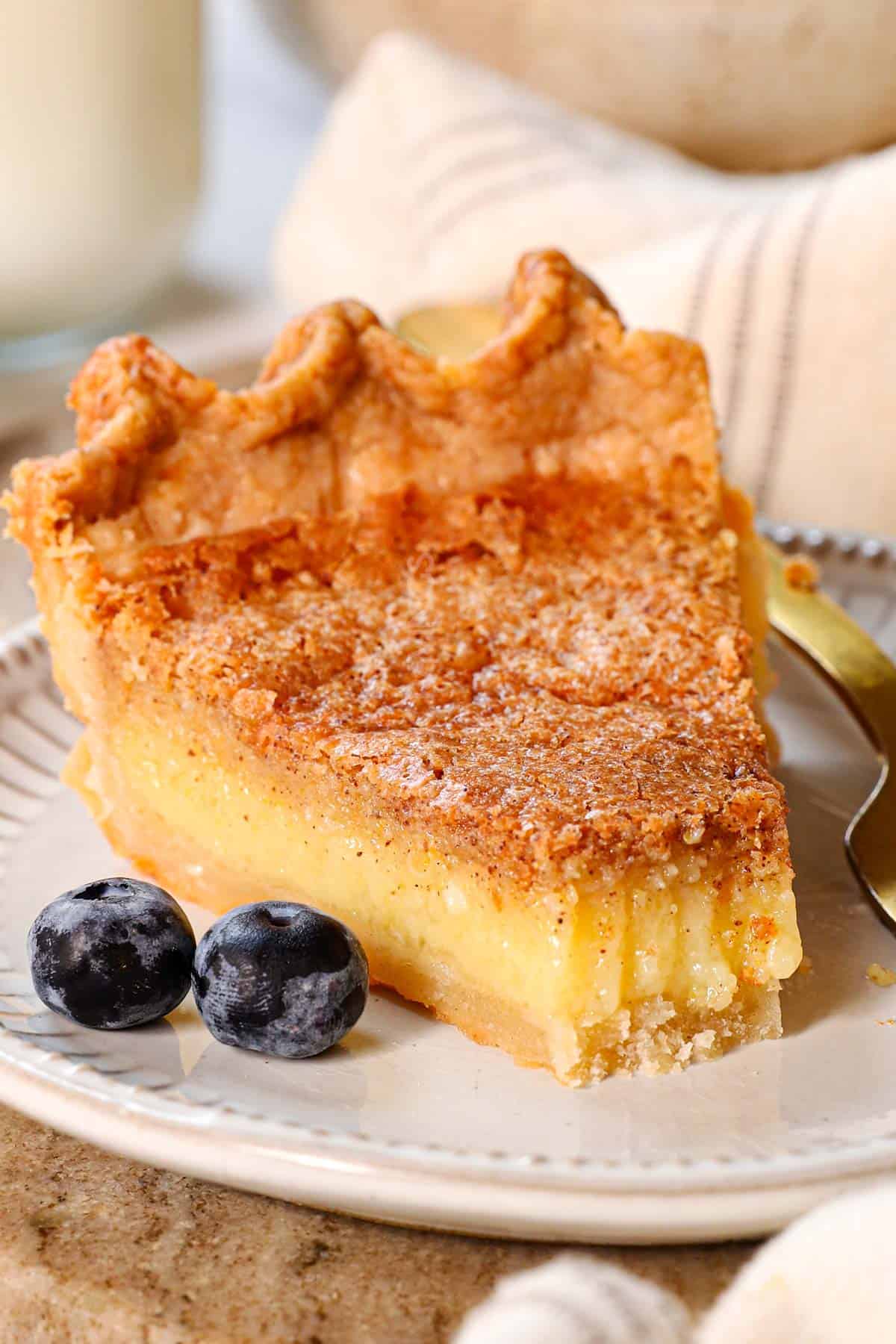
Buttermilk Chess Pie, Gluten Free
A true Southern chess pie: silky, tangy custard under a thin, crackly sugar top, all in a crisp all-butter shell. It's the simplest pie in the custard family and somehow the most addictive.
Ingredients
Makes One 9-inch pie
Crust
Filling
Instructions
- 1
Make the dough
Whisk the gluten-free blend, xanthan gum, sugar, and salt together in a wide bowl. Add the cold butter and rub it in until the mixture looks like coarse sand with a few flat, dime-sized pieces left. Drizzle in the ice water a tablespoon at a time, tossing with a fork. Gluten-free dough drinks more water than wheat dough, so expect to use all 5 tablespoons and to end up with something slightly tackier than you're used to — squeeze a handful, and if it holds without crumbling, stop.
- 2
Chill, then let it warm before rolling
Press the dough into a flat disc, wrap it, and refrigerate at least 1 hour so the starches hydrate fully — this is the single biggest thing that stops a gluten-free crust from cracking. Then let the disc sit at room temperature 10 to 15 minutes before rolling; cold gluten-free dough shatters. Roll it between two sheets of parchment into a 12-inch round, peel off the top sheet, and invert it into a 9-inch pie plate. Patch any tears with your fingers — there's no gluten to toughen, so you can press it back together freely. Crimp, then freeze 20 minutes.
- 3
Blind bake the shell
Heat the oven to 375°F with a rack in the lower third. Line the frozen shell with crumpled parchment and fill to the rim with pie weights. Bake 20 minutes, remove the parchment and weights, and bake 10 to 12 minutes more — gluten-free crust needs the extra few minutes to drive off moisture and firm up, and it should look dry and lightly golden across the bottom. Reduce the oven to 350°F and leave the shell on a baking sheet.
- 4
Whisk the dry ingredients
In a large bowl, whisk the granulated sugar, brown sugar, cornmeal, gluten-free blend, and salt until no lumps remain. Mixing the cornmeal with the sugar first keeps it evenly suspended instead of sinking into a gritty layer.
- 5
Build the filling and let it rest
Pour in the melted butter and whisk until the mixture looks like wet sand. Add the eggs and yolk and whisk just until smooth, then whisk in the buttermilk, vinegar, vanilla, lemon zest, and nutmeg, stirring rather than beating. Let the filling sit 20 minutes before baking so the rice and starch flours in the blend hydrate — skip this and the baked custard can taste faintly chalky. Give it one gentle stir to recombine before pouring.
- 6
Fill and bake
Set the blind-baked crust on its baking sheet, pour in the filling, and bake at 350°F for 40 to 50 minutes. Check at 30 minutes and tent the crimped edge with foil if it's darkening ahead of the filling.
- 7
Judge the doneness
Look for set, puffed edges and a center that wobbles as one unit, with a matte golden top. An instant-read thermometer in the center should read 175°F to 180°F. The gluten-free version browns a shade faster on top, so trust the thermometer and the wobble over color alone.
- 8
Cool completely
Cool on a wire rack at least 4 hours before slicing — gluten-free custard pies firm up a touch more slowly, and the crust crisps as it sits. Fine cracks across the top are normal.
You did it! Help us bring baking back home by selling your delicious baked goods on Homebaked!
Baker's Tips
- 1.
If all you have is medium-grind cornmeal, stir it into the buttermilk and let it sit for an hour before mixing the filling so it softens; otherwise it stays sandy in the baked custard.
- 2.
The vinegar isn't there to taste like vinegar. It cuts the sugar and makes the pie taste bright rather than cloying — don't skip it, and don't double it.
- 3.
For an extra-insured bottom crust, brush the hot blind-baked shell with a teaspoon of beaten egg white and let it set for a minute before filling. It seals the surface against the liquid custard.
- 4.
Buttermilk gives the tang; whole milk works in a pinch but the pie will read sweeter and flatter. Evaporated milk makes a richer, more old-fashioned version.
- 5.
Bake on a preheated baking sheet if your oven runs cool on the bottom. It helps the under-crust crisp while the custard sets gently above.
- 6.
Serve at room temperature or barely cool, with unsweetened whipped cream. A fridge-cold slice mutes the butter and vanilla.