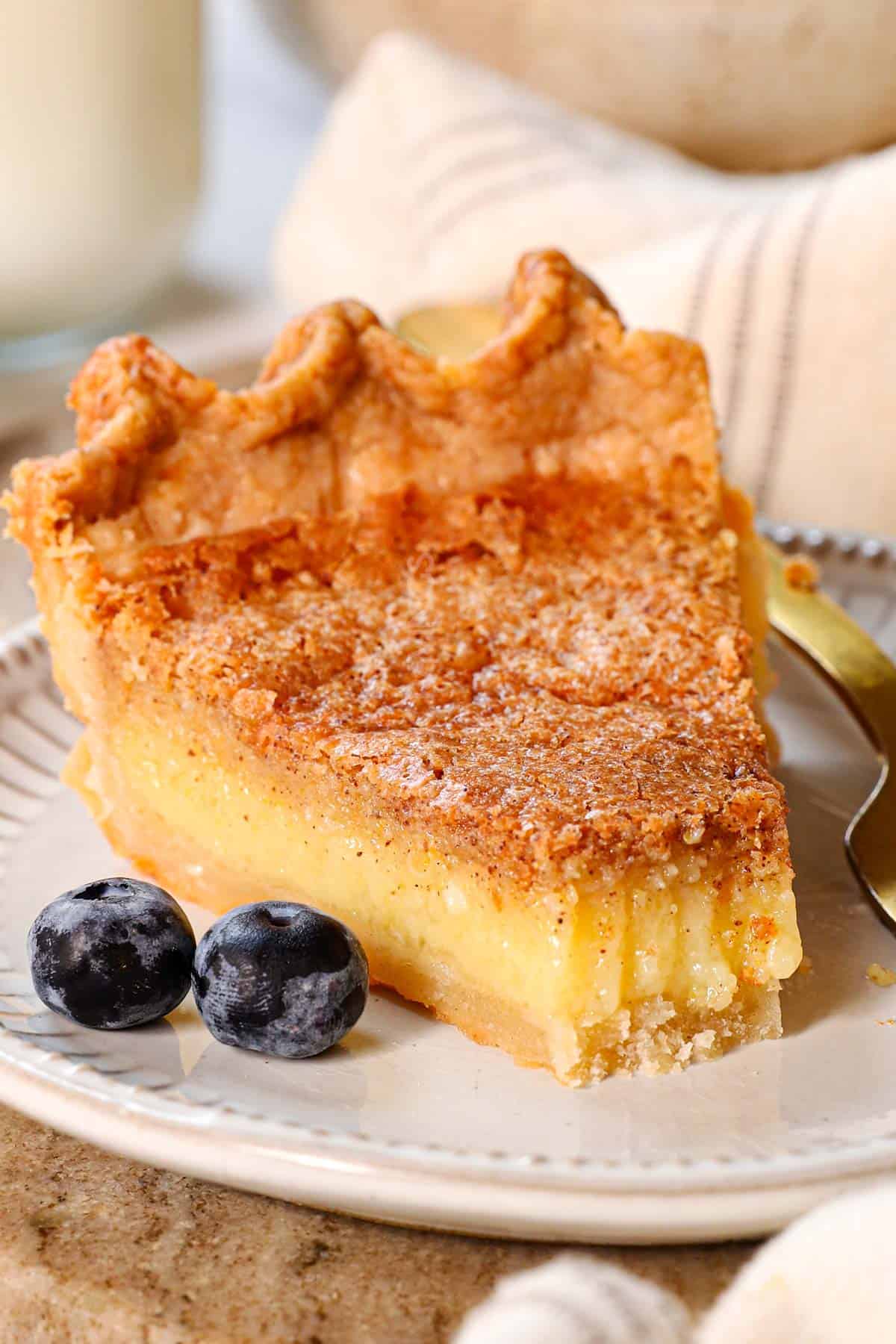
Buttermilk Chess Pie
A true Southern chess pie: silky, tangy custard under a thin, crackly sugar top, all in a crisp all-butter shell. It's the simplest pie in the custard family and somehow the most addictive.
Ingredients
Makes One 9-inch pie
Crust
Filling
Instructions
- 1
Make the dough
Whisk the flour, sugar, and salt together in a wide bowl. Add the cold butter and rub it in with your fingertips or cut it in with a pastry blender until most of the mixture looks like coarse sand with a few flat, dime-sized pieces left. You want a slightly tighter, sandier texture here than you would for a fruit pie, because a mealy crust resists a wet custard filling better. Drizzle in the ice water a tablespoon at a time, tossing with a fork, until the dough holds together when you squeeze a handful.
- 2
Chill, roll, and chill again
Press the dough into a flat disc, wrap it, and refrigerate at least 1 hour or up to 2 days. Roll it on a lightly floured counter into an 12-inch round, about 1/8 inch thick. Settle it into a 9-inch pie plate without stretching, trim to a 1-inch overhang, tuck the edge under, and crimp. Freeze the shell for 20 minutes — a thoroughly cold crust is what keeps the sides from slumping.
- 3
Blind bake the shell
Heat the oven to 375°F with a rack in the lower third. Line the frozen shell with a crumpled sheet of parchment and fill it to the rim with pie weights or dried beans. Bake 20 minutes, then lift out the parchment and weights and bake 8 to 10 minutes more, until the bottom looks dry and the edges are pale gold. Reduce the oven to 350°F and leave the shell on a baking sheet — you'll pour the filling into it while it's still warm.
- 4
Whisk the dry ingredients
In a large bowl, whisk the granulated sugar, brown sugar, cornmeal, flour, and salt until no lumps of brown sugar remain. Mixing the cornmeal with the sugar first keeps it evenly suspended instead of sinking into a gritty layer.
- 5
Build the filling
Pour in the melted butter and whisk until the mixture looks like wet sand. Add the eggs and the yolk and whisk just until smooth, then whisk in the buttermilk, vinegar, vanilla, lemon zest, and nutmeg. Stir rather than beat — air whipped into the filling turns into a foamy, puffed top instead of a tight crackly one. If the mixture looks slightly curdled, that's the vinegar and the buttermilk doing their job; it smooths out in the oven.
- 6
Fill and bake
Set the warm crust on its baking sheet, pour in the filling, and slide it into the 350°F oven. Bake 40 to 50 minutes. Check at the 30-minute mark and tent the crimped edge with a ring of foil if it's browning faster than the top of the filling.
- 7
Judge the doneness
The pie is ready when the outer two inches are set and puffed, the center still wobbles as a single unit when you nudge the pan, and the top has gone matte and golden with fine cracks. An instant-read thermometer in the center should read 175°F to 180°F. Pull it then — it carries over as it cools, and an extra five minutes is the difference between silky and weepy.
- 8
Cool completely
Cool on a wire rack for at least 4 hours before slicing. The custard finishes setting as it comes down to room temperature, and cutting early gives you a puddle instead of a clean wedge. Fine surface cracks are normal and nothing to worry about.
You did it! Help us bring baking back home by selling your delicious baked goods on Homebaked!
Baker's Tips
- 1.
If all you have is medium-grind cornmeal, stir it into the buttermilk and let it sit for an hour before mixing the filling so it softens; otherwise it stays sandy in the baked custard.
- 2.
The vinegar isn't there to taste like vinegar. It cuts the sugar and makes the pie taste bright rather than cloying — don't skip it, and don't double it.
- 3.
For an extra-insured bottom crust, brush the hot blind-baked shell with a teaspoon of beaten egg white and let it set for a minute before filling. It seals the surface against the liquid custard.
- 4.
Buttermilk gives the tang; whole milk works in a pinch but the pie will read sweeter and flatter. Evaporated milk makes a richer, more old-fashioned version.
- 5.
Bake on a preheated baking sheet if your oven runs cool on the bottom. It helps the under-crust crisp while the custard sets gently above.
- 6.
Serve at room temperature or barely cool, with unsweetened whipped cream. A fridge-cold slice mutes the butter and vanilla.
Equipment
- 9-inch pie plate (glass or metal)
- Rolling pin
- Parchment paper and pie weights or dried beans
- Large mixing bowl and whisk
- Rimmed baking sheet
- Instant-read thermometer
- Wire cooling rack
- Microplane or fine grater
Storage
Cool completely, then cover loosely and keep at room temperature for up to 1 day. Beyond that, refrigerate covered for up to 4 days and let slices sit out 30 minutes before serving to bring back the texture. To freeze, chill the whole cooled pie until firm, wrap in plastic and then foil, and freeze up to 1 month; thaw overnight in the refrigerator and warm at 300°F for 10 minutes to re-crisp the crust.