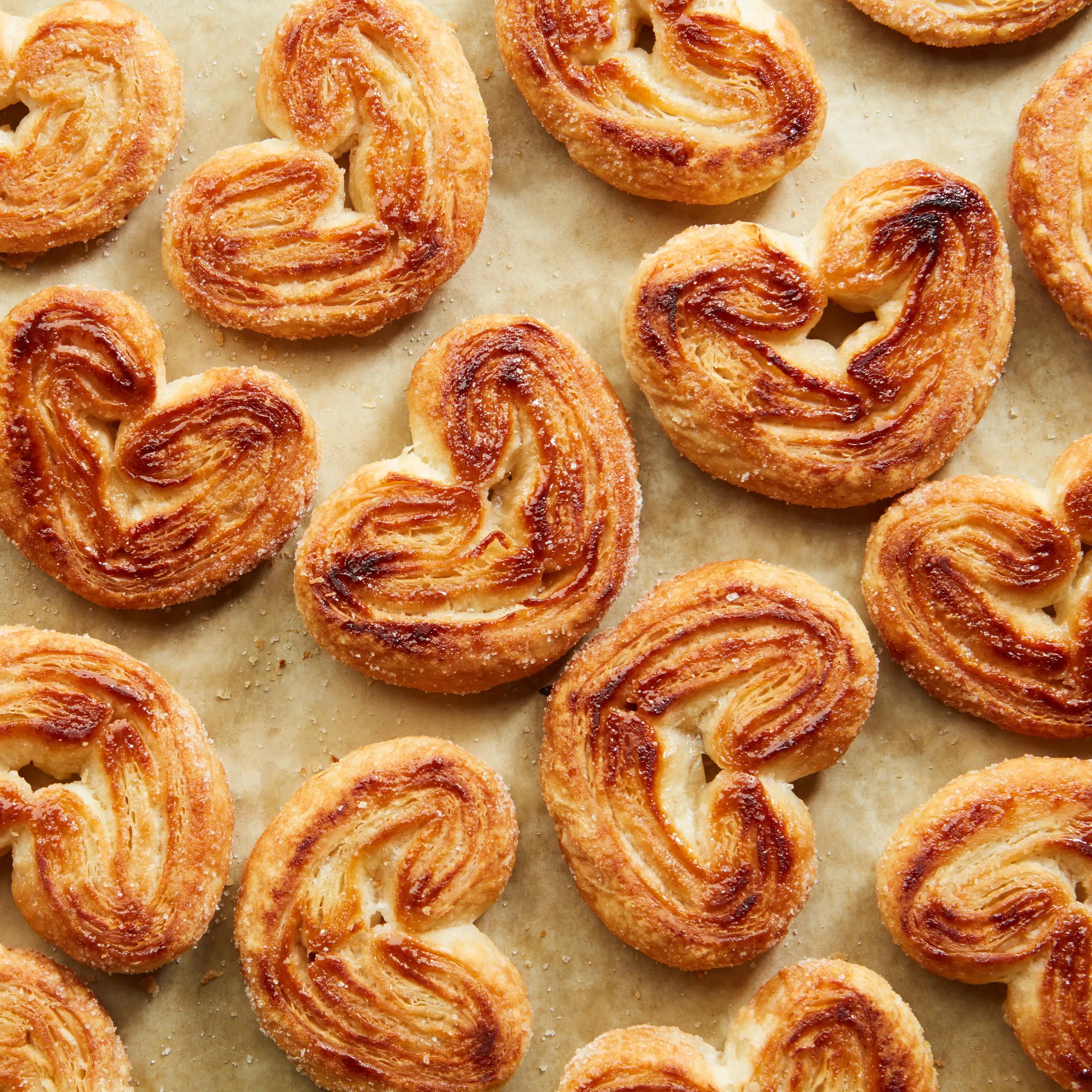
Palmiers
Crisp, deeply caramelized French palmiers made from a quick homemade rough puff pastry rolled in sugar. They look like fancy bakery work but come down to two real ingredients: butter-laminated dough and sugar that turns to glass in the oven.
Ingredients
Makes about 36 palmiers
Rough puff pastry
Sugar coating
Instructions
- 1
Mix the dough
Whisk the flour, 1 tablespoon sugar, and 3/4 teaspoon salt together in a wide bowl. Add the cold butter cubes and toss to coat, then press each cube flat between your fingers so you end up with a bowl of ragged butter flakes roughly the size of postage stamps. Big, visible pieces of butter are exactly what you want here, so stop well before the mixture looks sandy. Drizzle in the ice water, tossing with a fork until the dough starts clumping, then squeeze it together into a shaggy block. It will look dry and unpromising; resist adding more water beyond an extra tablespoon.
- 2
Laminate with letter folds
On a lightly floured counter, pat the block into a rough 6 by 9 inch rectangle. Fold it in thirds like a business letter, give it a quarter turn, and roll it out again to about 6 by 12 inches. Repeat the fold-turn-roll sequence three more times, for four folds total. The first fold will feel crumbly and the dough will want to fall apart at the edges; by the third it should be smooth and marbled with streaks of butter. If the butter ever starts to smear or feel greasy, stop and chill the dough for 20 minutes before continuing.
- 3
Chill
Wrap the dough tightly and refrigerate at least 1 hour, or up to 2 days. Cold dough is non-negotiable: the whole point is solid butter that turns to steam in the oven and pushes the layers apart.
- 4
Roll the dough in sugar
Stir the 1 cup sugar with the 1/4 teaspoon salt and the cinnamon, if using. Scatter about half of it over a clean work surface in a rectangle a little larger than your dough. Set the chilled dough on the sugar, cover the top with most of the remaining sugar, and roll out to a 12 by 16 inch rectangle, with a short side facing you. You are not sprinkling the sugar so much as pressing it into both faces of the dough with the rolling pin.
- 5
Fold the palmier shape
Mark the center of the rectangle lightly with the back of a knife. Fold the top and bottom edges in so they meet at that center line, then sprinkle the folded surface with any sugar left on the counter. Fold each of those edges in to the center line again, so you have four stacked layers on each side. Finally close the two halves together like a book and press gently along the seam. You should have a long log with the classic double-spiral profile at each end.
- 6
Chill the log until firm
Wrap the log and freeze it for 30 minutes, or refrigerate for at least 1 hour. A firm log slices cleanly instead of squashing, which is the difference between tidy hearts and lopsided blobs. Meanwhile, heat the oven to 400F and line two sheet pans with parchment.
- 7
Slice and space
Using a sharp, thin knife and a decisive downward motion, cut the log into slices a scant 1/2 inch thick. Lay them cut side up on the lined pans with a good 2 1/2 inches between them, and gently pinch the base of each one so it holds together. They spread to roughly double their width, so crowd them and you will bake one large sheet of palmier.
- 8
Bake and flip
Bake for 12 to 14 minutes, until the undersides are a glossy amber and the sugar is bubbling at the edges. Pull the pans out, flip each palmier with a thin spatula, and return them for another 5 to 8 minutes to caramelize the second side. Watch them closely at this stage; caramel goes from amber to burnt in under a minute.
- 9
Cool on a rack
Slide the parchment onto a wire rack and let the palmiers cool completely before you move them. They are soft and bendable straight from the oven and only crisp up as the sugar sets, so judge the texture once they are at room temperature, not before.
You did it! Help us bring baking back home by selling your delicious baked goods on Homebaked!
Baker's Tips
- 1.
Store-bought all-butter puff pastry works in place of the homemade dough. Thaw one 14-ounce sheet, roll it out on sugar, and pick the recipe up at step 4.
- 2.
Granulated sugar is the right choice for the coating because it melts into caramel. Powdered sugar dissolves into the dough and never crisps, and coarse sugars like demerara give a crunchier, less glassy finish if that is what you are after.
- 3.
The pinch of salt in the sugar is not optional in spirit, even if it is small. Straight sugar caramel tastes flat, and that quarter teaspoon is what makes these taste like a pastry rather than candy.
- 4.
Parchment, not a greased pan or a silicone mat. Melted sugar runs off the palmiers as they bake and will weld them to bare metal.
- 5.
The log freezes beautifully for up to 2 months. Slice from frozen, add 2 to 3 minutes to the bake, and you have fresh palmiers whenever you want them.
- 6.
If your palmiers unfurl in the oven, the log was too warm when you sliced it or the folds were too loose. Press the seams more firmly and chill longer next time.
Equipment
- Rolling pin
- Bench scraper
- Two rimmed baking sheets
- Parchment paper
- Sharp thin-bladed knife
- Wire cooling rack
- Plastic wrap
- Thin metal spatula
Storage
Store cooled palmiers in an airtight container at room temperature for up to 3 days; they are at their crispest on day one. Do not refrigerate, as the sugar draws moisture and turns them leathery. If they soften, crisp them on a parchment-lined sheet in a 300F oven for 4 to 5 minutes and cool completely. The unbaked log keeps wrapped in the freezer for up to 2 months.