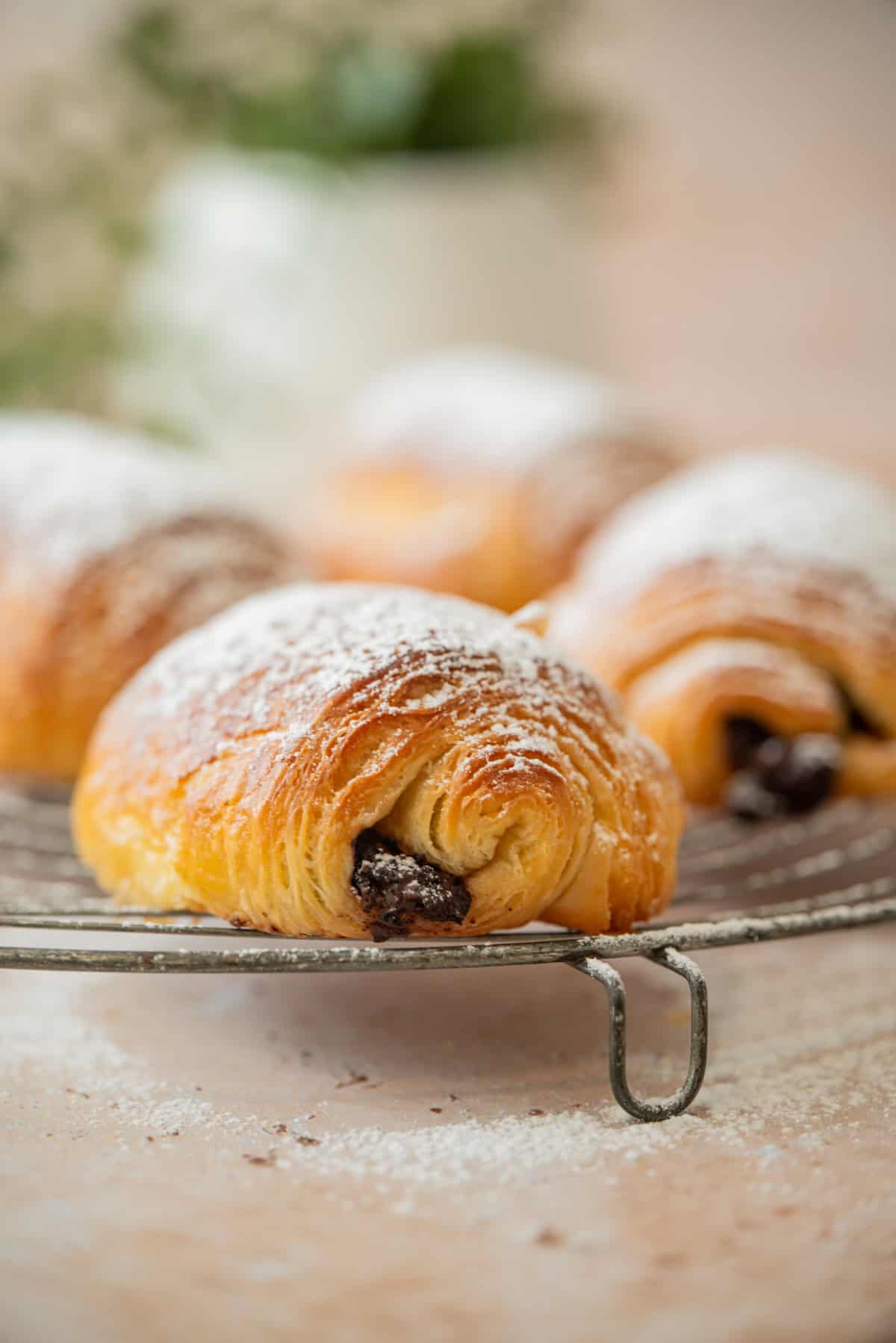
Pain au Chocolat
Shatteringly flaky laminated dough wrapped around two batons of dark chocolate, with a honeycomb crumb that pulls apart in buttery sheets. It takes two days, but almost all of that is the fridge doing the work.
Ingredients
Makes 12 pastries
Dough
Butter Block
Filling
Egg Wash
Instructions
- 1
Mix the dough (Day 1)
Whisk the flour, sugar, yeast, and salt together in the bowl of a stand mixer. Pour in the cold milk and water, add the softened butter, and mix on low with the dough hook until no dry flour remains. Raise to medium-low and knead for 5 to 6 minutes, until the dough is smooth and pulls cleanly from the sides of the bowl. You want it developed but not super-elastic — an overworked dough will fight you during rolling and snap back every time.
- 2
Chill overnight
Press the dough into a flat rectangle roughly 7 by 8 inches, wrap it tightly, and refrigerate for at least 8 hours or up to 16. This slow cold ferment builds the flavor that makes a homemade pastry taste like a bakery one, and it brings the dough down to the firm, cool temperature you need for lamination.
- 3
Build the butter block (Day 2)
Draw a 6-inch square on a sheet of parchment and flip it over so the ink stays off the butter. Lay the cold butter inside the lines, fold the parchment into a closed packet, and pound and roll it with a rolling pin until it fills the square in an even slab. Refrigerate for 20 to 30 minutes. The butter should bend like cold modeling clay without cracking — if it snaps, leave it at room temperature for 5 minutes; if it feels greasy, chill it longer.
- 4
Lock in the butter
On a lightly floured counter, roll the chilled dough into a 12 by 7-inch rectangle. Set the butter block in the center at a 45-degree angle so its corners point to the long edges, then fold all four flaps of dough over the butter like an envelope and pinch every seam closed. No butter should be peeking out anywhere.
- 5
First letter fold
Roll the packet away from you into a long rectangle about 20 by 8 inches, keeping the edges square and flouring sparingly as you go. Brush off excess flour, then fold it in thirds like a business letter. Wrap and refrigerate 45 minutes. Always roll in the direction the layers run, not across them.
- 6
Second and third folds
Repeat the roll-and-letter-fold twice more, turning the dough 90 degrees each time so the open seam is on your right before rolling, with a 45-minute chill between each. Three folds gives you 27 butter layers, which is the sweet spot for flaky-but-sturdy pastries. If butter ever starts smearing through the surface, stop and chill for 20 minutes before continuing.
- 7
Roll out and cut
After the final chill, roll the dough into a rectangle about 25 by 10 inches and a scant 1/4 inch thick. If it resists, let it rest 10 minutes and come back to it. Trim the edges square with a sharp knife or pizza wheel — sealed edges can't rise — then cut the sheet into 12 rectangles roughly 4 by 4 3/4 inches.
- 8
Shape around the chocolate
Lay a chocolate baton across the short edge of a rectangle, about half an inch in, and roll the dough over it one full turn. Set a second baton against the roll and finish rolling, ending with the seam underneath. Place seam-side down on a parchment-lined sheet pan, six per pan, leaving plenty of room to expand.
- 9
Proof until jiggly
Cover loosely and proof at 75 to 78°F for 2 to 3 hours. Never go above 80°F or the butter layers will melt and leak out. They're ready when they've nearly doubled, feel airy and pillowy, and wobble visibly when you nudge the pan. Underproofed pastries bake up dense and gummy inside, so give them the full time.
- 10
Wash and bake
Heat the oven to 400°F with a rack in the center. Beat the egg with the milk and brush a thin, even coat over the tops, avoiding the cut sides where the layers need to lift freely. Bake 10 minutes, drop the temperature to 375°F, and bake another 10 to 12 minutes until deeply bronzed. Pale pastries are underbaked pastries — push the color further than feels comfortable.
- 11
Cool before eating
Move them to a rack and wait at least 20 minutes. The interior is still setting straight out of the oven, and the chocolate is molten enough to burn. They're at their absolute best about an hour after baking.
You did it! Help us bring baking back home by selling your delicious baked goods on Homebaked!
Baker's Tips
- 1.
Plan it as a two-day bake: dough on day one, lamination and baking on day two. Rushing the chills is the single most common reason homemade lamination fails.
- 2.
A cool kitchen is your best tool. If your counter runs warm, chill the rolling pin and work in shorter bursts with extra fridge time.
- 3.
European-style butter with 82% or more fat stays pliable at cold temperatures and is far less likely to crack or shatter inside the dough.
- 4.
No chocolate batons? Cut a bar of 55 to 70% dark chocolate into sticks about 3 inches long and 1/3 inch thick. Chips are too small and sink into the layers.
- 5.
Shaped, unproofed pastries freeze beautifully for up to a month. Thaw and proof them on the counter for 3 to 4 hours, then bake as directed.
- 6.
A puddle of butter on the pan during baking means the lamination broke down or the proof was too warm — the pastries will still taste good, just with fewer layers.
Equipment
- Stand mixer with dough hook
- Rolling pin
- Ruler or tape measure
- Bench scraper
- Pizza wheel or sharp chef's knife
- Parchment paper
- Two rimmed baking sheets
- Pastry brush
- Instant-read thermometer
Storage
Best the day they're baked. Keep leftovers in a paper bag or loosely covered at room temperature for up to 2 days — an airtight container traps steam and softens the crust. Refresh in a 325°F oven for 5 to 7 minutes to bring back the crispness. For longer storage, freeze baked and fully cooled pastries in a sealed bag for up to 2 months, then reheat from frozen at 350°F for 10 to 12 minutes. Avoid refrigerating baked pastries; it makes them stale and leathery fast.