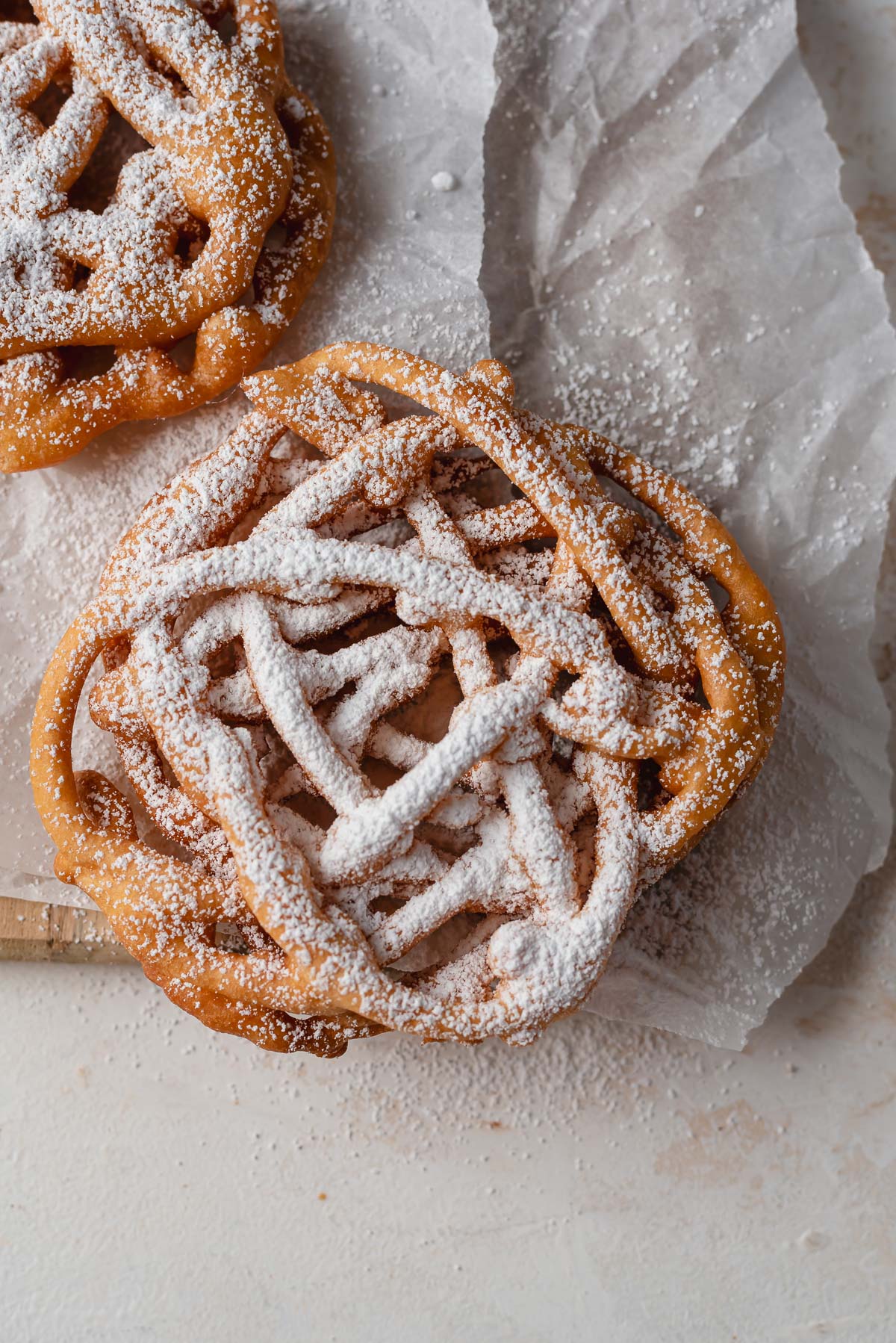
Funnel Cake
Crisp, lacy rings of fried batter under a snowdrift of powdered sugar — the state fair classic, made in your own kitchen in under half an hour. The batter comes together in one bowl while the oil heats.
Ingredients
Makes 6 funnel cakes
Batter
For Frying and Serving
Instructions
- 1
Get the oil heating
Pour the oil into a Dutch oven or other heavy, deep pot until it sits about 2 inches deep, leaving at least 3 inches of clearance to the rim. Clip on a deep-fry or candy thermometer and warm the oil over medium heat, aiming for 375°F. Reaching temperature takes a while, so start it now and mix the batter while you wait.
- 2
Set up your landing zone
Set a wire rack over a sheet pan next to the stove. Resist the urge to drain funnel cakes on paper towels — the trapped steam turns the underside soft within a minute. A rack lets air move underneath and keeps every surface crisp. Have a slotted spoon or spider skimmer and a pair of tongs within reach.
- 3
Whisk the dry ingredients
In a large bowl, whisk the flour, granulated sugar, baking powder, and salt until evenly blended. Taking thirty seconds here distributes the baking powder properly, which is what gives the fried strands their light, puffed interior instead of a dense, bready one.
- 4
Add the wet ingredients
In a second bowl, whisk the milk, eggs, melted butter, and vanilla until uniform and slightly frothy. Pour this into the dry ingredients and whisk just until the batter is smooth with no dry pockets. A few small lumps are fine; stop as soon as it comes together, since overworking the flour builds gluten and toughens the cakes.
- 5
Check the consistency
Lift the whisk and let the batter fall back into the bowl. It should run off in a steady, unbroken ribbon that sinks back in after a couple of seconds — thinner than muffin batter, thicker than cream. If it drips and splatters, whisk in a tablespoon of flour. If it drops in heavy blobs, add milk a tablespoon at a time. This single check matters more than anything else: batter that is too thin disintegrates into shreds in the oil, and batter that is too thick refuses to flow from the funnel.
- 6
Fill your funnel
Once the oil holds steady at 375°F, plug the spout of a funnel with your finger and ladle in about 1/2 cup of batter. No funnel? A liquid measuring cup with a good pour spout, a squeeze bottle, or a zip-top bag with a 1/2-inch corner snipped off all work just as well.
- 7
Pour the cake
Hold the funnel 3 to 4 inches above the oil and release your finger. Start a small spiral at the center and work outward to about 6 inches across, then drizzle a few passes back across the spiral in a criss-cross to lock the strands together. Move with purpose — the batter sets within seconds, and a slow pour gives you a thick puddle instead of lace. Plug the spout again the moment the cup is empty.
- 8
Fry until deep golden
Fry for about 2 minutes, until the underside is a rich golden brown and the edges look set and crisp. Slide two forks or tongs under the cake, flip it in one confident motion away from you, and fry the second side another 1 to 2 minutes. Lift it out, let the excess oil drip for a second, and set it on the rack.
- 9
Let the oil recover, then repeat
The oil temperature drops every time a cake goes in. Wait for the thermometer to climb back to 375°F before pouring the next one, nudging the heat up or down as needed. Fry one cake at a time — crowding the pot tanks the temperature and gives you greasy, pale results. Stir the batter briefly between cakes if it has started to settle.
- 10
Dust and serve immediately
Sift powdered sugar generously over each funnel cake while it is still hot, so it clings in a thick layer. Serve right away — funnel cakes are at their absolute best within five minutes of leaving the oil, and no amount of reheating fully recovers that first shattering crispness.
You did it! Help us bring baking back home by selling your delicious baked goods on Homebaked!
Baker's Tips
- 1.
A thermometer is non-negotiable here. Below 350°F the batter drinks oil and turns heavy and greasy; above 390°F the outside browns before the inside cooks through.
- 2.
Pour from higher above the oil than feels natural. A 3- to 4-inch drop stretches the batter into thin strands; pouring close to the surface gives you thick, doughy ropes.
- 3.
Chill the batter for 15 minutes if it feels loose. A slightly cold, slightly thickened batter holds its shape better as it hits the oil.
- 4.
Dust with powdered sugar only right before eating. Sugar applied to a cake that has sat for 10 minutes dissolves into damp patches.
- 5.
Beyond powdered sugar, try a drizzle of warm chocolate or caramel sauce, crushed strawberries with whipped cream, or a shake of cinnamon sugar while the cake is still hot and tacky.
- 6.
Strain the cooled frying oil through a coffee filter or fine-mesh sieve into a jar and keep it in a cool, dark cupboard. It is good for two or three more frying sessions.
- 7.
Making a batch for a crowd? Hold finished cakes on the rack in a 200°F oven for up to 20 minutes. They will not be quite as crisp as fresh, but they stay far better than they would on the counter.
Equipment
- Dutch oven or heavy deep pot
- Deep-fry or candy thermometer
- Funnel, squeeze bottle, or liquid measuring cup with spout
- Wire cooling rack set over a sheet pan
- Spider skimmer or slotted spoon
- Tongs
- Large mixing bowls
- Whisk
- Fine-mesh sieve for dusting
Storage
Funnel cakes are meant to be eaten within minutes of frying and do not store well. If you have leftovers, keep them uncovered at room temperature for up to 1 day and recrisp in a 375°F oven or air fryer for 3 to 4 minutes, dusting with fresh powdered sugar afterward. Do not refrigerate — the cold makes them limp and leathery. Unfried batter can be covered and refrigerated for up to 24 hours; whisk it well and thin with a splash of milk before using, as it thickens overnight.