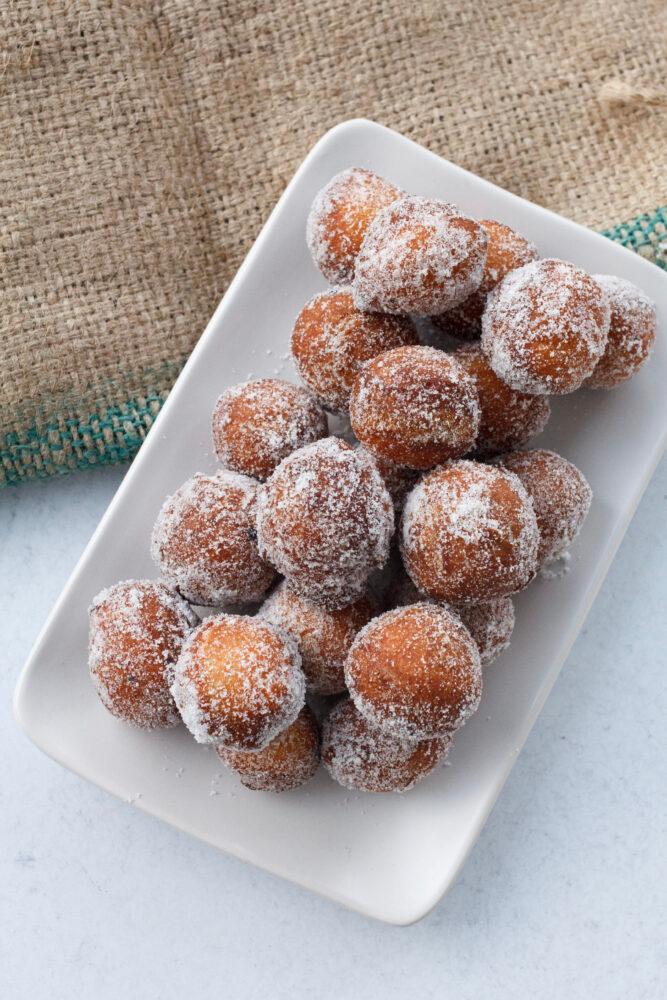
Buttermilk Cake Donut Holes
Scoopable buttermilk batter fried into crisp-edged, tender little spheres and tumbled in cinnamon sugar while still hot. No yeast, no rolling, no cutting — about forty minutes from bowl to breakfast.
Ingredients
Makes 30 donut holes
Donut holes
For frying
Cinnamon sugar coating
Instructions
- 1
Set up your landing zone
Before you touch the batter, get everything ready for hot donuts. Stir the 3/4 cup sugar and the cinnamon together in a wide shallow bowl. Set a wire rack over a rimmed baking sheet next to the stove. Frying moves fast, and you don't want to be hunting for a slotted spoon with oil at temperature.
- 2
Whisk the dry ingredients
In a large bowl, whisk the flour, 1/3 cup sugar, baking powder, baking soda, salt, and nutmeg until completely uniform — a solid 20 seconds of whisking. Pockets of baking soda will taste soapy, so take this seriously. The nutmeg is what makes these taste like a real cake donut rather than a fried pancake, so don't skip it.
- 3
Combine the wet ingredients
In a medium bowl, whisk the egg and vanilla together, then whisk in the buttermilk. Drizzle in the melted butter while whisking. If your buttermilk is cold straight from the fridge, the butter will seize into little flecks — harmless, but room-temperature buttermilk gives you a smoother batter.
- 4
Mix just barely
Pour the wet into the dry and fold with a flexible spatula until no dry flour remains, about 15 strokes. The batter should be thick, sticky, and a little lumpy — closer to drop-biscuit dough than cake batter. Stop the moment it comes together. Overmixing builds gluten and gives you tough, bready donut holes with tunnels inside.
- 5
Heat the oil to 350°F
Pour the oil into a heavy Dutch oven or deep pot; it should come up about 2 inches and sit at least 3 inches below the rim. Heat over medium until a clip-on thermometer reads 350°F (175°C). Temperature is the whole ballgame here: below 340°F the donut holes drink oil and turn greasy, above 365°F the outsides brown before the centers set.
- 6
Scoop and fry in batches
Using a 1-tablespoon cookie scoop or two spoons, drop rounded portions of batter into the oil, lowering them in close to the surface so they don't splash. Fry 6 to 8 at a time — crowding drops the oil temperature. They'll sink, then bob up and flip themselves partway; nudge them with a slotted spoon or spider so they color evenly. Fry 2 1/2 to 3 1/2 minutes total, until deep golden brown all over.
- 7
Check the first one
Pull one donut hole from the first batch, let it cool for a minute, and tear it open. The center should be cooked through and cakey, with no wet batter. If it's raw inside but dark outside, your oil is too hot — drop the heat and wait for it to settle back to 350°F. Adjust your scoop size down slightly if needed. One test donut saves the whole batch.
- 8
Drain and coat while hot
Lift the donut holes onto the wire rack and let them drip for about 30 seconds, then roll them through the cinnamon sugar while they're still hot — that's when the coating clings. Return them to the rack. Let the oil come back up to 350°F between batches, and give the batter a gentle stir before scooping again.
You did it! Help us bring baking back home by selling your delicious baked goods on Homebaked!
Baker's Tips
- 1.
No buttermilk? Stir 2 teaspoons of lemon juice or white vinegar into 3/4 cup of whole milk and let it sit for 10 minutes. It won't thicken much, but the acid is what you're after for the baking soda to react with.
- 2.
Keep the scoops small and even. A 1-tablespoon portion fries through in about 3 minutes; anything bigger than 1 1/2 tablespoons will brown outside before the middle sets.
- 3.
Fry a single test donut hole before the first real batch to calibrate your oil. It's the fastest way to find out if your thermometer and your stove agree.
- 4.
For a glaze instead of cinnamon sugar, whisk 1 cup powdered sugar (120g) with 2 tablespoons milk (30g) and 1/2 teaspoon vanilla, then dip the donut holes once they've cooled for about 5 minutes so the glaze sets instead of sliding off.
- 5.
Strain the cooled frying oil through a coffee filter and refrigerate it in a sealed jar — it's good for two or three more frying sessions.
- 6.
These are genuinely best within two hours of frying. If you want them for a morning, mix the dry ingredients the night before and whisk the wet together just before you heat the oil.
Equipment
- Heavy Dutch oven or deep heavy-bottomed pot
- Clip-on deep-fry or candy thermometer
- 1-tablespoon cookie scoop
- Slotted spoon or wire spider
- Wire cooling rack set over a rimmed baking sheet
- Large mixing bowl
- Medium mixing bowl
- Whisk and flexible spatula
Storage
Donut holes are at their peak within a couple of hours of frying. Store leftovers in an airtight container at room temperature for up to 2 days; the cinnamon sugar will dissolve and look damp, which is normal. Refresh them in a 300°F (150°C) oven for 4 to 5 minutes to bring back some crispness, then re-roll in fresh cinnamon sugar. Freeze uncoated donut holes in a zip-top bag for up to 2 months, reheat from frozen at 325°F (165°C) for 8 to 10 minutes, and coat while warm. Don't refrigerate them — they go stale and dense fast.