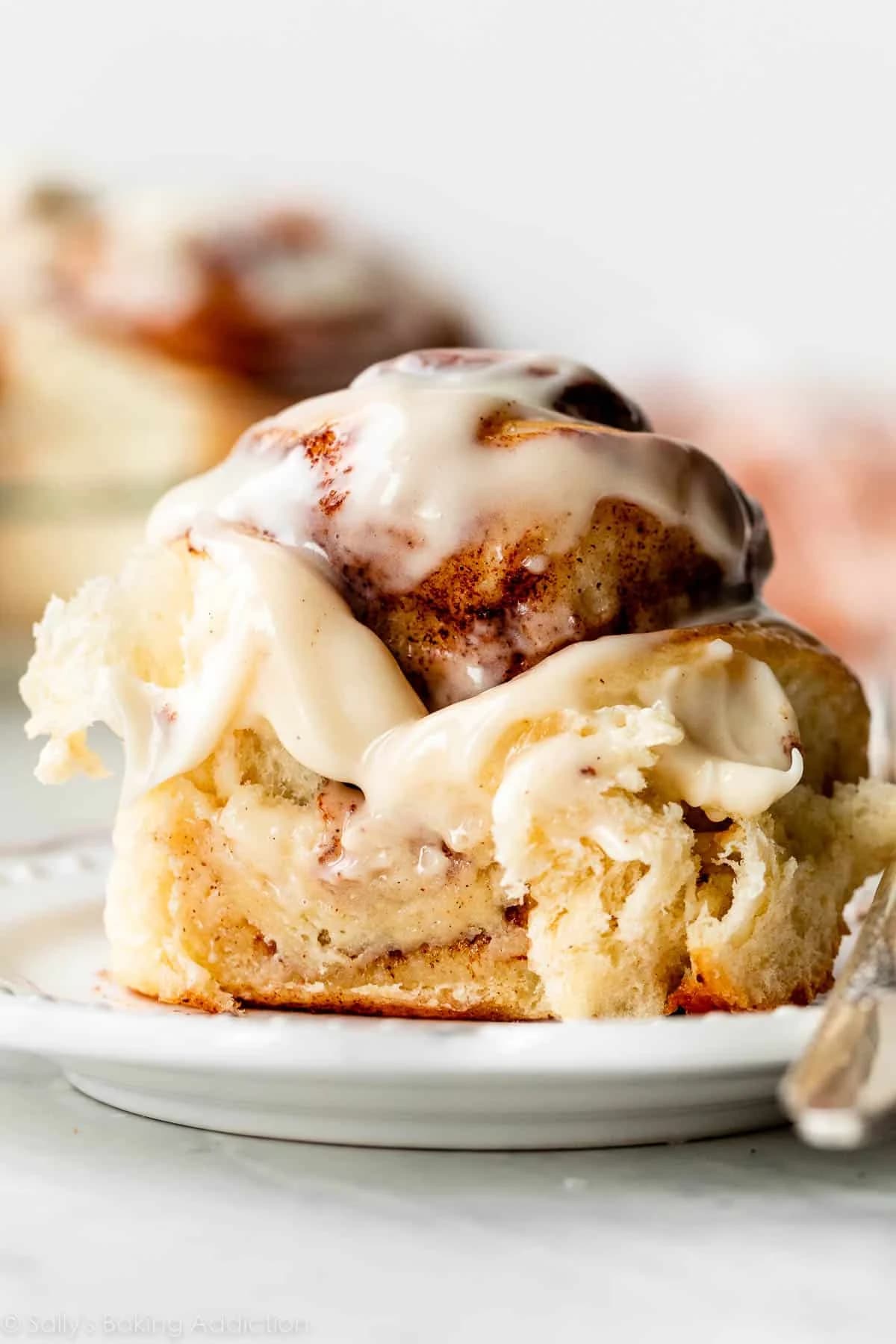
Soft Cinnamon Sweet Rolls
Pillowy enriched yeast rolls with a buttery cinnamon swirl and a pour-over vanilla glaze. They pull apart in soft sheets and taste best still warm from the pan.
Ingredients
Makes 12 rolls
Dough
Cinnamon filling
Vanilla glaze
Instructions
- 1
Warm the milk and butter
Combine the milk and the 6 tablespoons of butter for the dough in a small saucepan over low heat. Warm just until the butter melts, then pull it off the heat and let it cool to 105-110°F. If you dip a finger in and it feels pleasantly warm rather than hot, you're there. Anything above about 120°F will start killing yeast, so give it the extra few minutes if you're unsure.
- 2
Mix the dough
In the bowl of a stand mixer fitted with the dough hook, whisk together the granulated sugar, yeast, salt, and 2 cups of the flour. Pour in the warm milk mixture, then add the eggs and vanilla. Mix on low until there are no dry patches, about 1 minute. With the mixer running, add the remaining flour about 1/2 cup at a time, stopping once the dough gathers around the hook and pulls cleanly off the sides of the bowl. You may not need every last spoonful.
- 3
Knead
Knead on medium-low for 6 to 8 minutes, until the dough is smooth, springy, and slightly tacky to the touch. Resist the urge to add more flour to fix stickiness. A soft dough is what gives you soft rolls, and the flour will hydrate and firm up as it rises. By hand, this takes 10 to 12 minutes on a lightly floured counter.
- 4
First rise
Shape the dough into a ball, set it in a lightly oiled bowl, and turn it once to coat. Cover and let rise somewhere warm for 60 to 90 minutes, until doubled. To test it, press two fingers about half an inch into the dough; if the dent stays put rather than springing back, it's ready.
- 5
Make the filling
Stir the softened butter, brown sugar, cinnamon, and salt together into a smooth, spreadable paste. It should look like wet sand that holds together when pressed. Butter a 9x13-inch pan while you're at it.
- 6
Roll and fill
Turn the risen dough onto a lightly floured surface and press out the big air bubbles. Roll it into a rectangle roughly 16 by 12 inches, keeping the thickness even from edge to edge. Spread the filling all the way to three edges, leaving a bare 1-inch strip along one long side so the seam can seal.
- 7
Shape the rolls
Starting from the filled long edge, roll the dough into a snug log, keeping gentle, even tension as you go. Too tight and the filling squeezes out the ends; too loose and the rolls unravel. Pinch the bare seam closed, then cut the log into 12 equal pieces with unflavored dental floss or a very sharp serrated knife. Floss is the cleanest method: slide it under the log, cross the ends over the top, and pull.
- 8
Second rise
Arrange the rolls cut side up in the buttered pan with a little space between them. Cover loosely and let rise 45 to 60 minutes, until puffy and just touching their neighbors. Heat the oven to 350°F near the end of this rise.
- 9
Bake
Bake on a center rack for 22 to 26 minutes, rotating the pan halfway through. The tops should be deep golden and the center rolls should register 190-195°F on an instant-read thermometer. If the tops are browning fast but the middle is still soft, tent loosely with foil for the last several minutes.
- 10
Glaze and serve
Whisk the powdered sugar, melted butter, milk, vanilla, and salt until smooth and pourable, adding milk a teaspoon at a time if it's too thick. Let the rolls cool about 10 minutes, then pour the glaze over while they're still warm so it settles into every crevice. Serve warm.
You did it! Help us bring baking back home by selling your delicious baked goods on Homebaked!
Baker's Tips
- 1.
Weigh your flour if you can. A cup scooped straight from the bag can run 30g heavy, and in an enriched dough that's the difference between pillowy and dense.
- 2.
Softened filling butter means softened, not melted. Melted butter runs out of the log during baking and leaves a hollow gap under the swirl.
- 3.
To bake these for breakfast, assemble through shaping, cover the pan tightly, and refrigerate overnight. Pull it out in the morning and let the rolls sit at room temperature 1 to 2 hours until puffy before baking.
- 4.
If your kitchen is cold, set the covered bowl in an oven that's off with just the light on. The ambient warmth is usually right around the 75-80°F sweet spot for rising.
- 5.
For a tangier finish, beat 4 ounces of softened cream cheese into the glaze and spread rather than pour it.
- 6.
Pull the rolls at the low end of the bake time if you plan to reheat them. They'll finish setting from residual heat and stay softer on day two.
Equipment
- Stand mixer with dough hook (or a sturdy bowl and your hands)
- 9x13-inch baking pan
- Small saucepan
- Rolling pin
- Instant-read thermometer
- Unflavored dental floss or sharp serrated knife
- Kitchen scale
Storage
Cover the pan tightly and keep at room temperature for up to 2 days, or refrigerate up to 5 days. Reheat individual rolls in the microwave for 15-20 seconds to bring back the soft crumb. To freeze, wrap unglazed baked rolls individually and freeze up to 3 months; thaw at room temperature, warm in a 300°F oven for about 10 minutes, then glaze.