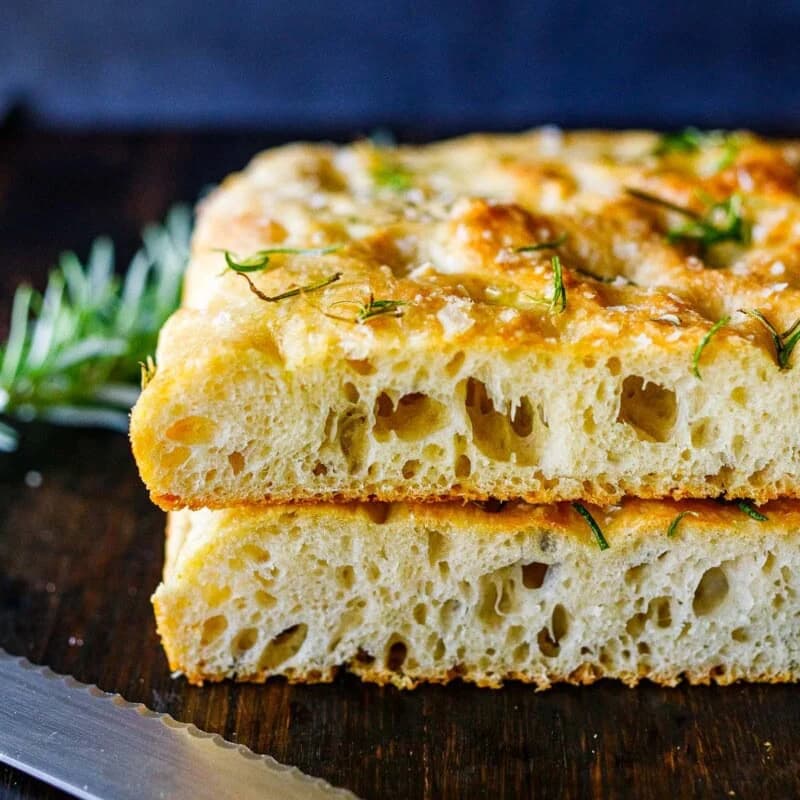
Rosemary Sea Salt Focaccia, Gluten Free
A no-knead, overnight dough that bakes into a pillowy slab with a shatter-crisp, olive-oil-fried bottom and deep dimples full of rosemary and flaky salt. Ten minutes of actual work; the fridge does the rest.
Ingredients
Makes One 9x13-inch focaccia (12 pieces)
Dough
Pan and Topping
Instructions
- 1
Mix the dough
Stir the honey into the warm water until it dissolves. In a large bowl, whisk the gluten-free blend, xanthan gum, yeast, fine sea salt, and baking powder until completely uniform — gums clump if you add them to liquid, so disperse them in the dry ingredients first. Pour in the honey water and the 3 tablespoons of olive oil and beat vigorously with a spatula or a mixer on medium for 2 minutes. You are after a thick, sticky, scoopable batter that mounds on the spatula, not a kneadable ball.
- 2
Rest to hydrate the starches
Cover the bowl and let it sit at room temperature for 25 minutes. Rice flours and starches absorb water slowly, and this rest is what prevents a gritty, chalky crumb. The batter will thicken noticeably and look less wet by the end. Skip the stretching and folding — there is no gluten to develop, and working it will only knock out air.
- 3
Spread into the pan
Pour 3 tablespoons of olive oil into a 9x13-inch metal pan and tilt to coat the bottom and sides. Scrape the batter in and spread it to the corners with an oiled spatula or oiled fingertips, aiming for an even layer. Smooth the top — unlike wheat dough, this will not level itself out as it rises, so whatever surface you leave is what you will bake.
- 4
Proof in a warm spot
Cover loosely and let rise somewhere warm for 60 to 90 minutes, until the surface looks domed and puffy and small bubbles appear around the edges. Gluten-free dough rises once and only once, and it will not double the way wheat dough does — a 50 percent increase is the target. Do not push for more; overproofed gluten-free batter has no structure to hold and will collapse in the oven.
- 5
Heat the oven
About 25 minutes before baking, set a rack in the lower third of the oven and heat it to 425°F. Let it come fully up to temperature before the pan goes in.
- 6
Dimple and dress
Whisk the tablespoon of warm water into the 2 tablespoons of olive oil and pour it over the surface. Oil your fingers and press dimples in rows about an inch apart, going most of the way down but stopping just short of the pan floor — this batter is more fragile than wheat dough and poking all the way through leaves holes that will not close. Scatter the rosemary and flaky salt over the top.
- 7
Bake
Bake for 28 to 34 minutes, rotating once halfway, until the top is golden and the edges are well browned and crisp. Gluten-free focaccia needs longer than wheat and is easy to underbake; the center should register 205 to 210°F on an instant-read thermometer, and the underside should look deeply browned when you lift a corner. A pale, soft middle means it needs more time.
- 8
Cool completely in the pan's shadow
Slide the focaccia out onto a wire rack and let it cool at least 25 minutes before cutting. Gluten-free crumb sets as it cools, and slicing it hot leaves the inside gummy and sticky. Once cool, cut into 12 squares with a serrated knife.
You did it! Help us bring baking back home by selling your delicious baked goods on Homebaked!
Baker's Tips
- 1.
Weigh the flour if you can. A cup scooped straight from the bag can run 30g heavy, and that extra flour is what turns a light, bubbly focaccia into a dense one.
- 2.
Use a light-colored metal pan rather than glass or ceramic. Metal conducts heat fast enough to crisp the oil-coated bottom; glass insulates and leaves it soft and pale.
- 3.
Bread flour works in place of all-purpose and gives a chewier, slightly taller crumb. Keep the water the same.
- 4.
The dimples need to go all the way to the bottom of the pan. If you only press halfway, the dough puffs up and swallows them, and the oil and salt slide off the top instead of pooling.
- 5.
Dried rosemary burns and turns bitter at this temperature. Use fresh, and toss it with a little of the oil first if your leaves are very fine.
- 6.
Easy variations: press halved cherry tomatoes, thin lemon slices, pitted olives, or slivers of garlic into the dimples after brining. Anything delicate should be tucked into a well rather than left on the surface.
- 7.
Running late on the final proof? Dough that is still cold in the center will bake up gummy. Give it the full time it needs — watch the dough, not the clock.