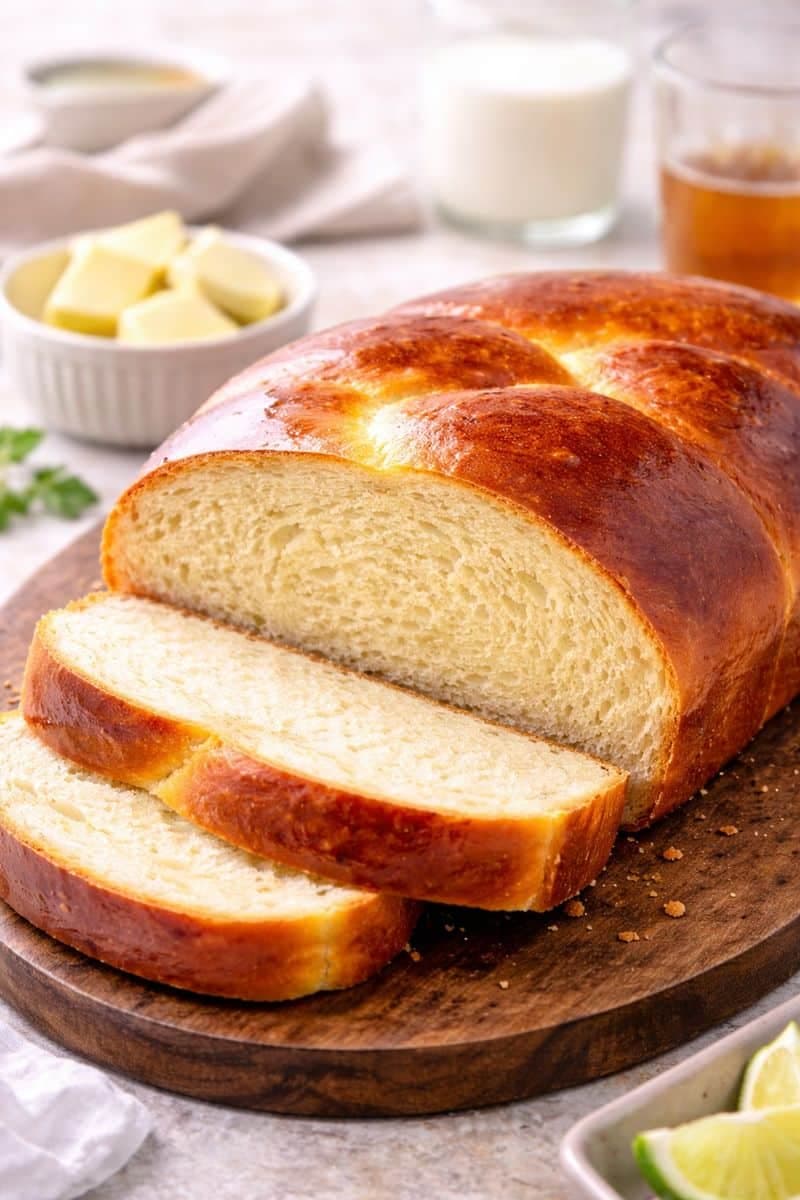
Soft Sweet Loaf Bread
A tender, lightly sweet yeast loaf enriched with milk, butter, and honey, with a feathery crumb that pulls apart in soft sheets. It makes exceptional toast and even better French toast.
Ingredients
Makes 1 loaf (about 12 slices)
Dough
Egg Wash
Instructions
- 1
Wake up the yeast
Warm the milk until it feels like bath water, around 105 to 110°F — hotter than that and you will kill the yeast. Stir in the honey until it dissolves, sprinkle the instant yeast over the top, and leave it alone for 5 to 10 minutes. You are looking for a foamy, slightly domed surface. If nothing happens, your yeast is dead and it is worth starting over now rather than three hours from now.
- 2
Mix the dough
Whisk the flour, sugar, and salt together in the bowl of a stand mixer fitted with the dough hook. Pour in the milk mixture, then add the egg and vanilla. Mix on low for about 2 minutes, just until there are no dry pockets left and the dough looks shaggy and rough. Let it sit for 5 minutes so the flour can drink up the liquid.
- 3
Work in the butter
With the mixer on low, add the softened butter one tablespoon at a time, waiting until each piece disappears before adding the next. The dough will look greasy and broken for a minute or two — that is normal, keep going. Once all the butter is in, raise the speed to medium-low and knead for 8 to 10 minutes.
- 4
Check the gluten
The dough is ready when it pulls away from the sides of the bowl, feels smooth and springy, and is tacky to the touch without actually sticking to your fingers. Pinch off a piece and stretch it: if it thins out enough to see light through before it tears, you are done. Resist adding extra flour — a soft dough is what makes this loaf tender.
- 5
First rise
Scrape the dough into a lightly oiled bowl, turn it once to coat, and cover it. Let it rise somewhere warm for 1 to 1 1/2 hours, until doubled. Judge by size, not by the clock — a cool kitchen can easily double that time, and a warm one can halve it.
- 6
Shape the loaf
Press the dough down gently to release the big bubbles and turn it out onto a lightly floured counter. Pat it into a rectangle roughly 9 by 12 inches with a short side facing you. Roll it up tightly from the near edge, pressing as you go to keep air out, then pinch the seam shut. Set it seam-side down in a greased 9x5-inch loaf pan.
- 7
Second rise
Cover the pan loosely and let the loaf rise for 45 to 60 minutes, until the dough crowns about an inch above the rim of the pan. Poke it lightly with a floured finger: the dent should fill back in slowly and only partway. Preheat the oven to 350°F during the last 20 minutes.
- 8
Wash and bake
Beat the egg with the milk and brush a thin, even layer over the top of the loaf, letting it run down the sides. Bake for 33 to 38 minutes, until deep golden brown and registering 190 to 195°F in the center. Sugar and egg wash brown fast, so tent the loaf with foil if it darkens before the 25-minute mark.
- 9
Cool before slicing
Let the loaf rest in the pan for 10 minutes, then turn it out onto a wire rack. Wait at least an hour before cutting — the crumb is still setting, and slicing into it hot will leave you with a gummy, compressed texture. For a softer crust, brush the warm top with a little melted butter.
You did it! Help us bring baking back home by selling your delicious baked goods on Homebaked!
Baker's Tips
- 1.
Of the 2 1/2 hours of prep time, only about 30 minutes is hands-on — the rest is the dough rising on its own schedule.
- 2.
An instant-read thermometer takes all the guesswork out of this loaf. Color lies, internal temperature does not.
- 3.
If your kitchen runs cold, turn the oven on to its lowest setting for 2 minutes, turn it off, and let the dough rise inside with the door shut.
- 4.
The dough should feel soft and slightly tacky after kneading. Every extra spoonful of flour you add buys you a drier, denser loaf.
- 5.
Swap the honey for maple syrup, or knead in a tablespoon of orange zest with the butter for a brighter, Portuguese-style loaf.
- 6.
Baking in a glass or dark metal pan? Drop the oven to 335°F, since both brown the sides faster than light aluminum.
Equipment
- Stand mixer with dough hook and paddle attachment
- 9x5-inch loaf pan
- Digital kitchen scale
- Instant-read thermometer
- Large mixing bowl
- Bench scraper
- Pastry brush
- Wire cooling rack
Storage
Once fully cooled, keep the loaf in an airtight bag or wrapped tightly in plastic at room temperature for 3 to 4 days. Skip the refrigerator — it drives staling faster than the counter does. For longer storage, slice the loaf first, then freeze it in a sealed bag for up to 3 months and toast slices straight from frozen. The gluten-free loaf dries out faster, so freeze whatever you will not finish within 2 days.