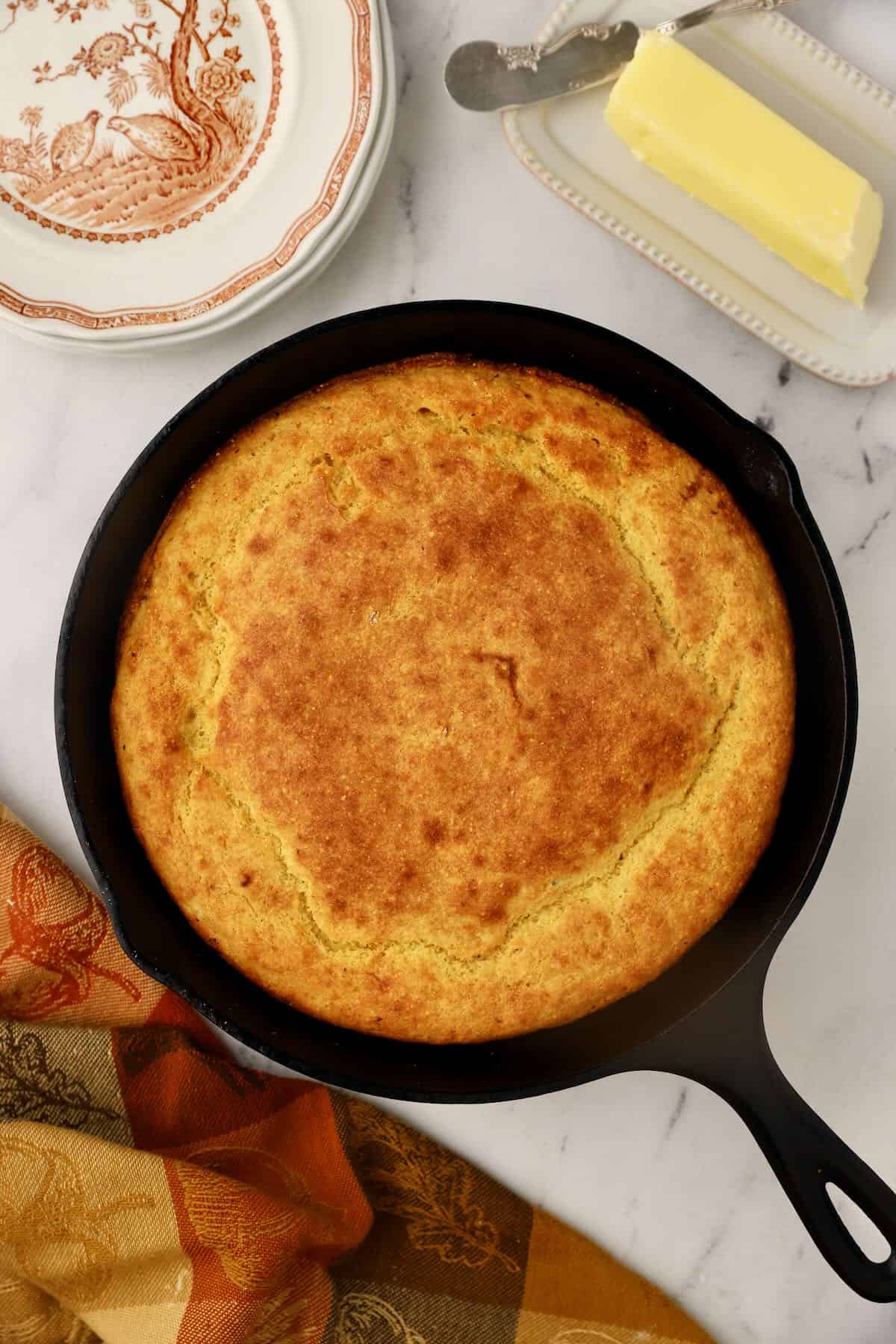
Buttermilk Skillet Cornbread
A cast iron cornbread with a crackling buttery crust and a moist, tender crumb underneath. Just sweet enough to eat plain, savory enough to sit next to a bowl of chili.
Ingredients
Makes 1 10-inch round, 8 wedges
Dry ingredients
Wet ingredients
For the skillet
Instructions
- 1
Preheat the oven with the skillet inside
Set a rack in the middle of the oven, put a 10-inch cast iron skillet on it, and heat the oven to 425°F. Leave the skillet in there for a full 10 minutes after the oven beeps. A genuinely hot pan is what gives you that crisp, lacy edge instead of a pale, soft one.
- 2
Whisk the dry ingredients
In a large bowl, whisk the cornmeal, flour, sugar, baking powder, baking soda, and salt until evenly combined, about 20 seconds. Break up any lumps of cornmeal with your fingers as you go — they won't dissolve later.
- 3
Whisk the wet ingredients
In a second bowl or a large measuring cup, whisk the buttermilk, eggs, and honey until smooth. Then pour in the melted butter in a thin stream while whisking. If your buttermilk and eggs are cold, the butter will seize into little flecks — it still bakes fine, but room-temperature dairy gives you a smoother batter.
- 4
Combine, barely
Pour the wet mixture into the dry and fold with a rubber spatula just until no dry pockets remain, roughly 12 to 15 strokes. The batter should be lumpy and pourable, about the consistency of pancake batter. Overmixing develops the flour's gluten and turns cornbread tough and rubbery, so stop while it still looks a little shaggy.
- 5
Butter the hot pan and pour
Pull the skillet out with a dry oven mitt and set it on the stovetop. Drop in the 2 tablespoons of butter and swirl it around the bottom and up the sides — it should foam and smell nutty almost immediately. Pour the batter straight into the center and let it spread on its own. You want to hear it sizzle when it hits.
- 6
Bake until deep golden
Return the skillet to the oven and bake 22 to 26 minutes, until the top is a deep golden brown, the edges have pulled slightly from the pan, and the center springs back when you press it. A toothpick should come out with a few moist crumbs, not wet batter. If you have an instant-read thermometer, the center should read 200 to 205°F.
- 7
Rest, then cut
Let the cornbread sit in the skillet for 10 minutes. It needs that time to finish setting — cut it straight out of the oven and the crumb will be gummy. Slide a thin spatula around the edge, then cut into 8 wedges and serve warm with butter.
You did it! Help us bring baking back home by selling your delicious baked goods on Homebaked!
Baker's Tips
- 1.
Fine-grind cornmeal gives a soft, cake-like crumb; medium grind gives you more texture and corn flavor. Coarse grind will feel gritty unless you soak it in the buttermilk for 20 minutes first.
- 2.
No buttermilk? Stir 1 tablespoon of lemon juice or white vinegar into 1 1/4 cups of whole milk and let it sit for 10 minutes. The acidity matters here — it's what activates the baking soda.
- 3.
For true Southern-style cornbread, drop the sugar and honey entirely and use 3 tablespoons of bacon fat in place of the skillet butter. It will taste savory and look darker.
- 4.
An 8-inch or 9-inch square metal pan works if you don't have cast iron. Grease it well, preheat it empty for 5 minutes, and add 2 to 4 minutes to the bake time since the batter will be deeper.
- 5.
Stir up to 1 cup of add-ins into the finished batter — sharp cheddar, drained corn kernels, minced jalapeño, or chopped scallions. Any more than that and the crumb gets heavy and wet.
- 6.
Day-old cornbread is better than fresh for stuffing and croutons. Cube it, leave it out overnight, and it'll hold its shape instead of dissolving.
Equipment
- 10-inch cast iron skillet
- Two mixing bowls
- Balloon whisk
- Rubber spatula
- Dry oven mitt or pan handle cover
- Measuring cups and spoons, or a kitchen scale
- Toothpick or instant-read thermometer
Storage
Cover the cooled cornbread tightly or transfer wedges to an airtight container and keep at room temperature for up to 3 days — refrigeration dries it out fast. To freeze, wrap individual wedges in plastic, then foil, and freeze for up to 3 months. Reheat wedges in a 325°F oven for 8 to 10 minutes, or split and toast them cut-side down in a buttered skillet until the edges crisp up again.