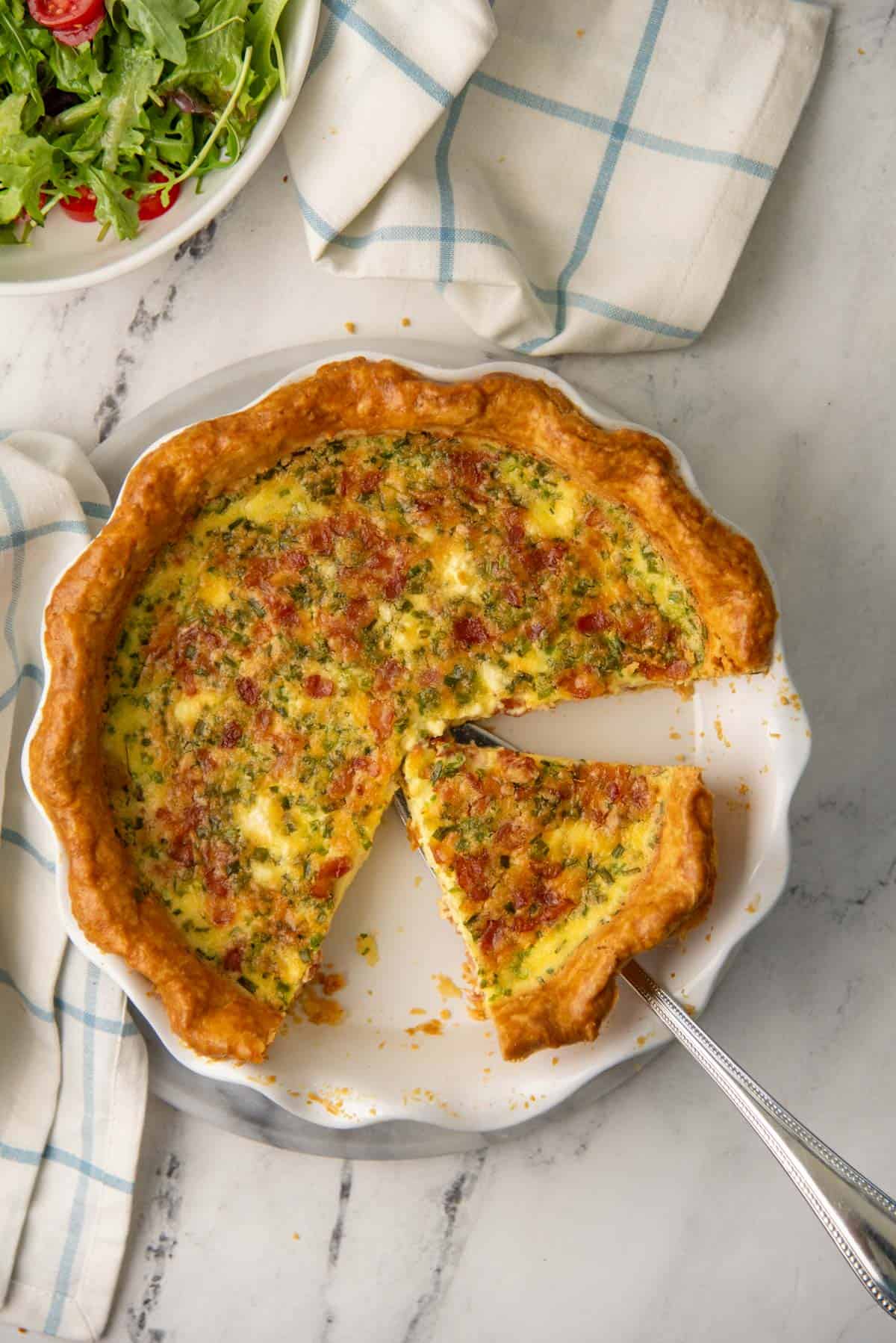
Classic Quiche with an All-Butter Crust, Gluten Free
A crisp, deeply golden pastry shell holding a custard so silky it barely holds its shape, shot through with bacon, sweet shallots, and nutty Gruyère. Bake it low and pull it while the center still wobbles, and you'll never serve a rubbery quiche again.
Ingredients
Makes one 9-inch quiche (8 slices)
Crust
Filling
Instructions
- 1
Cut the butter into the flour
Whisk the gluten-free blend, xanthan gum, and salt together in a wide bowl. Scatter the cold butter over the top and press each cube flat between your fingertips until the mixture looks like coarse gravel with visible flat shards of butter. Gluten-free dough can't be overworked into toughness the way wheat dough can, but those butter flakes still do the lifting, so keep them intact.
- 2
Bring the dough together and let it hydrate
Whisk the egg yolk, vinegar, and ice water together, then drizzle it over the flour, tossing with a fork. Add more water a teaspoon at a time until a squeezed handful holds without cracking; gluten-free blends usually drink up a bit more liquid than wheat flour. Press into a disk, wrap tightly, and refrigerate at least 1 hour — this rest is non-negotiable here, since the rice flour and starches need time to absorb moisture or the dough will crack and crumble when you roll it.
- 3
Roll and fit the shell
Roll the disk between two sheets of parchment into a 13-inch round about 1/8 inch thick. Peel off the top sheet, invert the dough into a 9-inch pie plate, and peel away the second sheet. If it tears, just press the pieces back together with your fingers — gluten-free dough patches invisibly and won't suffer for the handling. Ease it into the corners, trim to a 1-inch overhang, fold under, and crimp. Freeze the shell solid, about 30 minutes.
- 4
Blind bake until the crust is set and golden
Heat the oven to 400°F with a rack in the lower third. Line the frozen shell with parchment and fill completely to the rim with pie weights. Bake 20 minutes, remove the parchment and weights, and return for 10 to 14 minutes. Gluten-free crust browns more slowly and needs to go a shade deeper than you'd think — a pale shell will taste starchy and raw. Brush the inside with beaten egg white, bake 2 minutes more, then drop the oven to 325°F.
- 5
Cook the bacon and shallots
While the crust bakes, cook the bacon in a skillet over medium heat until crisp, 8 to 10 minutes. Drain on paper towels and pour off all but about a tablespoon of fat. Add the shallots and cook gently 4 to 5 minutes until soft but not browned. Let both cool completely before they meet the custard.
- 6
Whisk the custard
Whisk the eggs until uniform, then whisk in the cream, milk, salt, pepper, and nutmeg. Work gently — beating air in gives you a domed, spongy set. Skim off any foam.
- 7
Fill the shell
Scatter the bacon, shallots, Gruyère, and chives over the warm crust. Set the pie plate on a baking sheet already on the oven rack, then pour the custard in place, leaving about 1/4 inch of clearance at the rim.
- 8
Bake low and pull it early
Bake at 325°F for 40 to 50 minutes, until the edges are puffed and set and a 2- to 3-inch circle in the center jiggles as one loose unit. The center should read 170 to 175°F on an instant-read thermometer. Tent the crust edges with foil if they darken ahead of the filling.
- 9
Rest before slicing
Cool on a rack at least 30 minutes, and ideally 45 for a gluten-free crust — the starches firm up considerably as they cool, which is what gives you a clean, crisp-bottomed slice. Serve warm or at room temperature.
You did it! Help us bring baking back home by selling your delicious baked goods on Homebaked!
Baker's Tips
- 1.
Grate the Gruyère yourself. Pre-shredded cheese is coated in starch that can make the custard grainy rather than smooth.
- 2.
Any filling works as long as it's cooked and well drained first. Raw vegetables release water into the custard and leave you with a soupy center — sauté mushrooms, spinach, or zucchini and squeeze out the moisture before they go in.
- 3.
Keep total add-ins to about 2 1/2 cups. Overload the shell and there isn't enough custard left to bind everything into a sliceable whole.
- 4.
If the edges of the crust start getting too dark during the custard bake, cover them loosely with a ring of foil.
- 5.
A metal or ceramic pie plate browns the base far better than glass. If glass is what you have, blind bake on the lowest rack and give it a few extra minutes.
- 6.
Quiche is better the second day in some ways, but reheat it low and slow at 300°F for 15 to 20 minutes. A microwave turns the custard watery.