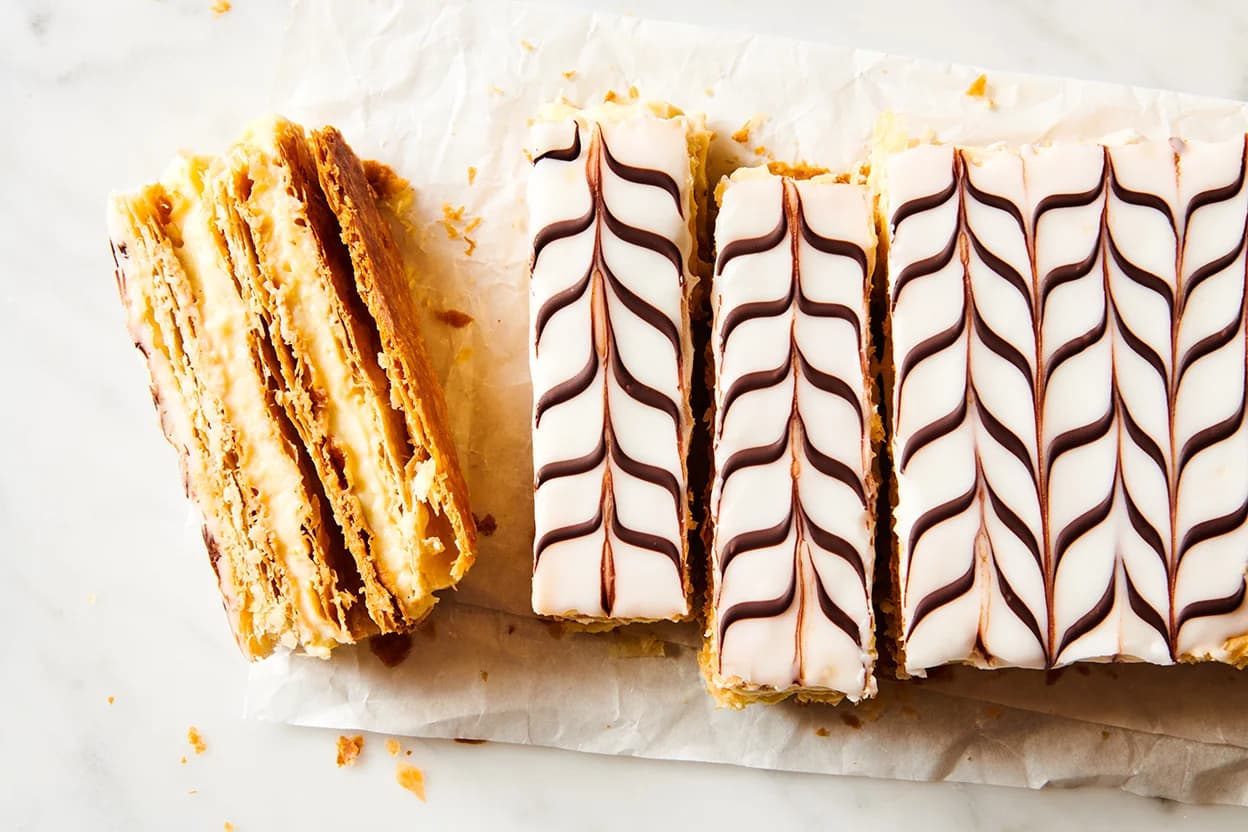
Classic Napoleons
Shatteringly crisp layers of puff pastry sandwiched with cool vanilla diplomat cream, finished with a glossy feathered glaze. It looks like a patisserie window display but comes together with one package of store-bought puff pastry.
Ingredients
Makes 8 napoleons
Pastry Layers
Vanilla Diplomat Cream
Feathered Glaze
Instructions
- 1
Cook the pastry cream
Warm the milk in a medium saucepan over medium heat until you see wisps of steam and small bubbles creeping up the sides. While it heats, whisk the granulated sugar, cornstarch, and salt together in a bowl, then whisk in the egg yolks until the mixture is pale, thick, and completely smooth with no dry pockets of starch.
- 2
Temper and thicken
Pour about a third of the hot milk into the yolks in a thin stream while whisking hard, then return everything to the saucepan. Cook over medium heat, whisking constantly and scraping the corners, until the cream thickens and bubbles lazily break the surface. Let it bubble for a full 60 seconds once it is thick, which is what cooks out the raw starch taste and keeps it from thinning back out later.
- 3
Finish and chill the cream
Pull the pan off the heat and whisk in the butter and vanilla until glossy. Press the cream through a fine mesh sieve into a shallow dish to catch any bits of cooked egg, then lay plastic wrap directly on the surface so a skin cannot form. Refrigerate at least 3 hours, or overnight.
- 4
Roll and dock the pastry
Heat the oven to 400°F and line two baking sheets with parchment. On a lightly floured counter, roll each cold pastry sheet into a rectangle roughly 10 by 14 inches and a scant 1/8 inch thick. Prick the entire surface all over with a fork, every inch or so. Docking is not optional here, since you want controlled lift and flat layers rather than one dramatic dome.
- 5
Bake under weight
Lay a second sheet of parchment over each rectangle and set an empty baking sheet on top as a weight. Bake 15 minutes, then lift off the top pan and parchment, dust the surface evenly with powdered sugar, and bake another 10 to 15 minutes until deep golden brown and lacquered. Pale pastry tastes doughy and goes soft fast, so take the color further than feels comfortable. Cool completely on a rack.
- 6
Cut the layers
Using a ruler and a serrated knife, saw gently through each cooled sheet to make twelve rectangles about 4 by 2 1/2 inches, 24 total. Let the knife do the work with long, light strokes; pressing down will crush the layers. Set aside the 8 tidiest pieces for the tops.
- 7
Lighten the cream
Whip the cold heavy cream to soft, droopy peaks. Whisk the chilled pastry cream by itself until it loosens and turns satiny, then fold the whipped cream in with a spatula in two additions. Scoop it into a piping bag fitted with a 1/2-inch round tip.
- 8
Mix the glaze
Whisk the powdered sugar, milk, corn syrup, and vanilla until smooth and glossy. You want the thickness of warm honey, thin enough to settle into a flat sheet but thick enough that it does not run off the edges. Adjust with a few drops of milk or an extra spoonful of sugar. Melt the chocolate gently and transfer it to a small piping bag or zip-top bag with a tiny corner snipped off.
- 9
Glaze and feather the tops
Spread a thin layer of glaze over the 8 reserved top pieces. Working immediately, pipe parallel chocolate lines across each one about 1/2 inch apart, then drag a toothpick through them perpendicular to the lines, alternating direction each pass. The glaze must still be wet for the pattern to set in, so glaze and feather one or two at a time. Let the tops set for 15 minutes.
- 10
Assemble
Pipe snug rows of cream onto a base rectangle, set a second rectangle on top, press very lightly to level it, pipe a second layer of cream, and crown it with a feathered top. Repeat for all eight. Assemble within an hour or two of serving, because the pastry starts drinking moisture from the cream the moment they meet.
You did it! Help us bring baking back home by selling your delicious baked goods on Homebaked!
Baker's Tips
- 1.
Keep the puff pastry cold right up until it hits the oven. If it softens while you roll or cut, slide it onto a sheet pan and chill 15 minutes; warm butter leaks out instead of creating steam, and you lose the layers.
- 2.
If your pastry cream looks grainy or scrambled, whisk it hard off the heat and then sieve it. Nine times out of ten it comes back perfectly smooth.
- 3.
Chill the pastry cream fully before folding in whipped cream. Fold warm cream and the whipped cream collapses into soup.
- 4.
An offset spatula and a bench scraper make assembly far less nerve-racking than trying to lift fragile layers with your fingers.
- 5.
Serve napoleons with a serrated knife and cut straight down with a sawing motion, or the cream squeezes out the sides.
- 6.
For a cleaner look, trim 1/4 inch off all four edges of each baked sheet before cutting rectangles so every piece shows crisp, exposed layers.
Equipment
- Two rimmed baking sheets
- Parchment paper
- Rolling pin
- Medium heavy-bottomed saucepan
- Balloon whisk
- Fine mesh sieve
- Shallow dish for chilling the cream
- Electric mixer or hand whisk
- Piping bag with 1/2-inch round tip
- Small piping bag or zip-top bag for chocolate
- Serrated knife
- Ruler
- Offset spatula
- Wire cooling rack
- Toothpick or skewer
Storage
Napoleons are at their best within 2 to 3 hours of assembly, while the pastry still shatters. Refrigerate leftovers in a single layer in an airtight container for up to 2 days; the layers will soften but still taste good. To work ahead, keep the pastry cream covered in the fridge for up to 3 days and store the baked, uncut pastry sheets at room temperature in an airtight container for up to 2 days, re-crisping them in a 350°F oven for 5 minutes if needed. Do not freeze assembled napoleons.