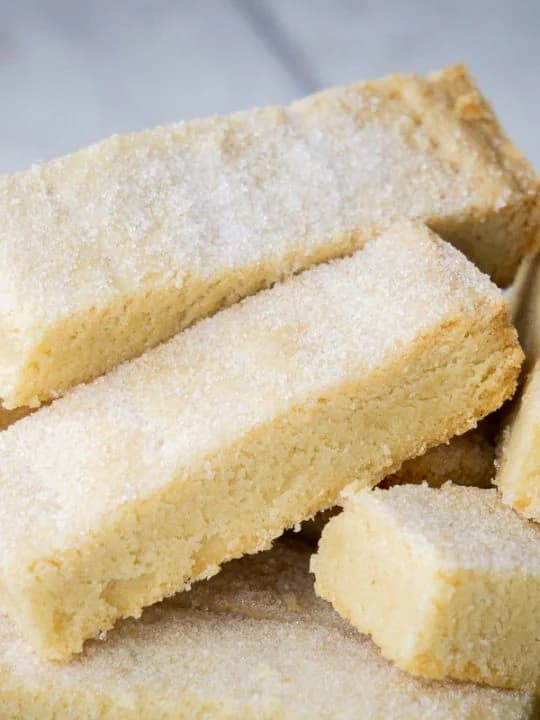
Classic Scottish Shortbread Fingers
Four pantry ingredients bake into pale gold fingers with crisp edges and a sandy crumb that collapses the second it hits your tongue. The low oven and a spoonful of cornstarch are what separate great shortbread from merely good.
Ingredients
Makes 24 shortbread fingers
Dough
Finishing
Instructions
- 1
Line the pan and heat the oven
Heat the oven to 325°F with a rack in the center. Line a 9-inch square pan with parchment, letting two sides hang over the edge so you can lift the slab out later. A low oven is deliberate here — shortbread should dry out and turn pale gold rather than brown, and a hotter oven will color the edges long before the middle is set.
- 2
Blend the butter and sugar
Beat the softened butter and powdered sugar together on medium-low speed for about 1 minute, just until smooth and no lumps of sugar remain. Resist the urge to cream it pale and fluffy — air is the enemy of a dense, sandy shortbread, and an over-whipped dough will puff and then sink in the pan.
- 3
Add the vanilla and salt
Beat in the vanilla and salt until evenly distributed, scraping down the bowl and the paddle once. The salt does a lot of work in a recipe this plain, so make sure it's fully dispersed rather than sitting in a pocket.
- 4
Work in the flour and cornstarch
Whisk the flour and cornstarch together, then add them all at once and mix on the lowest speed until the dough looks like damp, clumpy sand and no dry flour remains, 30 to 60 seconds. Squeeze a handful — it should hold together when pressed. Stop as soon as it does; extra mixing builds gluten and turns shortbread tough instead of tender.
- 5
Press it into the pan
Tip the crumbly dough into the lined pan and press it into an even layer with your fingertips, pushing it well into the corners. Smooth the top with the flat bottom of a measuring cup or an offset spatula. An even thickness matters more than a pretty surface — thin spots will overbake while thick spots stay doughy.
- 6
Dock and chill
Prick the dough all over with a fork, going right down to the bottom of the pan in rows about an inch apart. Those holes let steam escape so the slab doesn't dome. Chill the pan in the refrigerator for 30 minutes to firm the butter, which keeps the edges sharp and the texture short.
- 7
Bake low and slow
Bake for 38 to 45 minutes, until the surface looks dry and matte, the edges are a light golden tan, and the center is set when you press it gently. The middle should still look pale — that's correct. If the top is browning, your oven runs hot; drop it to 315°F for the remaining time.
- 8
Score hot, cool completely
Set the pan on a rack and immediately cut the hot slab into 24 fingers with a thin sharp knife, pressing straight down rather than dragging. Sprinkle with turbinado sugar if using. Leave the fingers in the pan to cool for at least an hour — they firm up and crisp as they cool, and lifting them warm will snap them.
You did it! Help us bring baking back home by selling your delicious baked goods on Homebaked!
Baker's Tips
- 1.
Weigh the flour if you can. A heavy-handed cup of flour is the single most common reason shortbread turns out dry and chalky instead of melting.
- 2.
Butter at cool room temperature — around 65°F, pliable but still slightly firm to the touch — gives the best texture. Greasy, over-soft butter makes a dough that spreads and bakes up dense.
- 3.
Shortbread is better on day two. Overnight rest lets the flavor round out and the crumb settle into its proper sandy snap.
- 4.
For a crunchier, more rustic bite, swap the cornstarch for an equal volume of fine rice flour. Cornstarch gives the softer, melt-in-your-mouth version.
- 5.
Flavor variations go in with the vanilla: finely grated lemon or orange zest, a tablespoon of chopped rosemary, or a half teaspoon of almond extract all work without changing the ratios.
- 6.
If the baked slab seems soft when it comes out, trust the cooling. Shortbread sets as the butter resolidifies, so judge doneness by color and dryness rather than firmness.
Equipment
- 9-inch square baking pan
- Parchment paper
- Stand mixer with paddle, or hand mixer
- Kitchen scale
- Fork for docking
- Thin sharp knife
- Wire cooling rack
Storage
Store cooled shortbread in an airtight tin at room temperature for up to 2 weeks, with parchment between layers. Keep the container well sealed — humidity softens the crisp texture fast. Unbaked dough can be pressed into the pan, wrapped, and refrigerated for 3 days or frozen for 3 months; bake from frozen, adding about 10 minutes. Baked fingers freeze well for 3 months and thaw at room temperature in about 30 minutes.