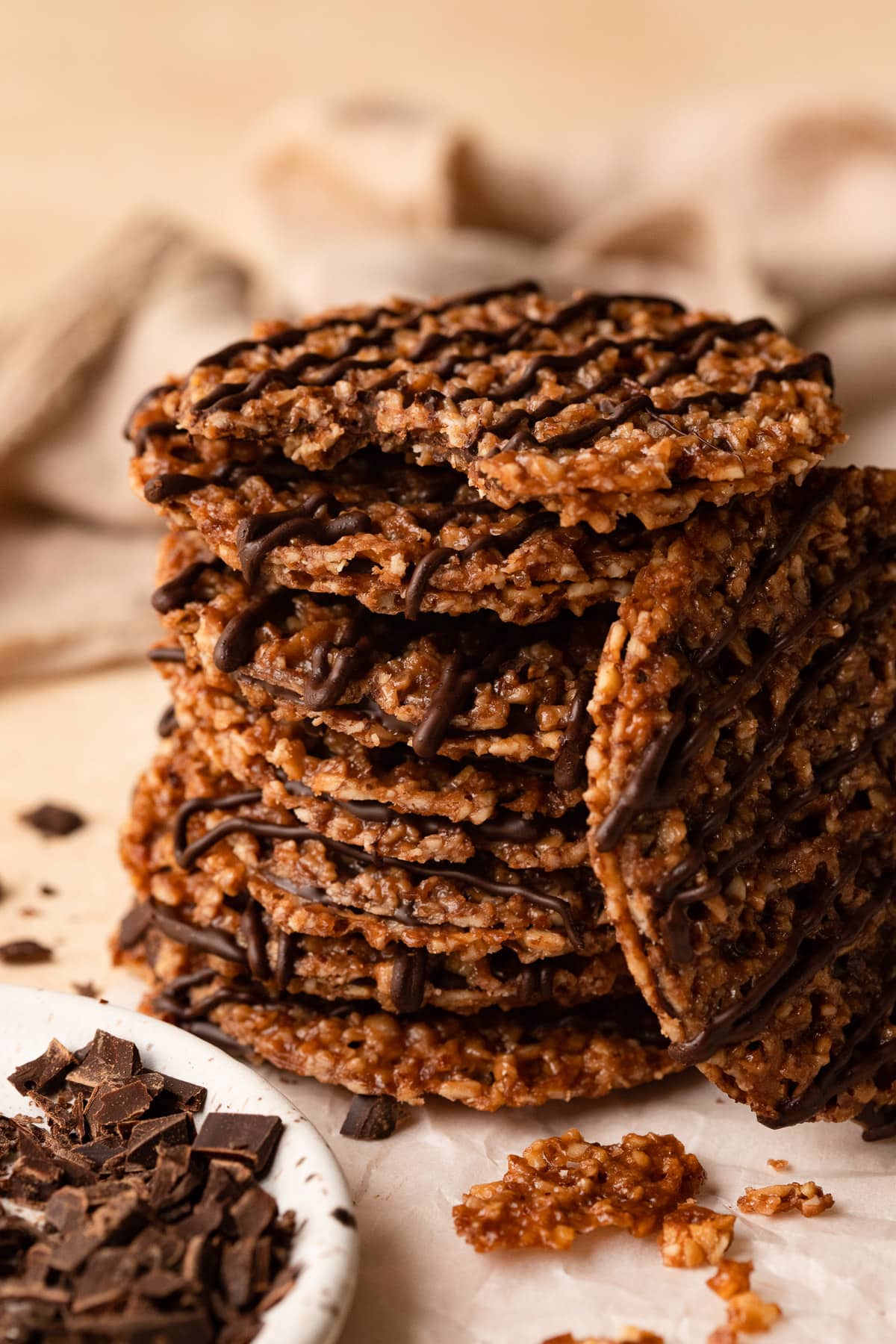
Almond Florentines, Gluten Free
Thin, lacy almond cookies built on a boiled honey-caramel base, baked until they bubble into golden webs and finished with a sheet of dark chocolate on the underside. They shatter when you bite them.
Ingredients
Makes 28 cookies
Almond mixture
Caramel base
Chocolate backing
Instructions
- 1
Heat the oven and line your pans
Set a rack in the middle of the oven and heat to 350°F (175°C). Line two heavy baking sheets with parchment. Don't grease the pans and don't skip the parchment — this batter is essentially caramel, and it will weld itself to bare metal. Silicone mats work too, though they bake a slightly thicker, chewier cookie than parchment does.
- 2
Toss the almond mixture
In a medium bowl, whisk together the sliced almonds, gluten-free flour blend, xanthan gum if your blend doesn't already contain it, the candied orange peel if you're using it, and the orange zest. Whisk the blend and gum thoroughly before the almonds go in — xanthan clumps instantly once it meets liquid. Rub the zest through with your fingers so it distributes evenly.
- 3
Boil the caramel base
Combine the butter, both sugars, cream, honey, and salt in a heavy saucepan over medium heat. Stir steadily until the butter melts and the mixture looks smooth and glossy, with no grittiness when you drag the spoon across the bottom. Bring it up to a full rolling boil — one you can't stir down — and let it boil for 90 seconds, then pull it off the heat immediately. That short boil drives off just enough water to set the cookies crisp; boil much longer and you're making toffee.
- 4
Fold in the almonds and rest the batter longer
Stir the vanilla into the hot caramel, then fold in the almond mixture gently until every slice is coated — rough stirring snaps the almonds and ruins the lacy look. Now let the batter rest 25 to 30 minutes rather than the usual 15, stirring once or twice. Rice and starch flours absorb liquid far more slowly than wheat does, and this longer rest is what prevents a sandy, gritty texture in the finished cookie. The batter is ready when it mounds on the spoon instead of running off.
- 5
Scoop and flatten
Drop level tablespoons onto the sheets, no more than six per pan, spacing them a full 3 to 4 inches apart — gluten-free batter spreads a touch wider than wheat-based. Dampen your fingertips with water and press each mound into a flat disc about 2 inches across. Keep the remaining batter at room temperature between batches; if it stiffens too much, warm the pan over low heat for 30 seconds.
- 6
Bake until deeply golden throughout
Bake one sheet at a time for 10 to 12 minutes. Gluten-free Florentines need that extra minute or two, and the cue is color rather than time: the bubbling should reach the center and the color should be a uniform deep amber edge to edge, with no pale spot in the middle. A pale center means trapped moisture and a chewy, bendy cookie. Pull them while the centers still look molten — they crisp as they cool.
- 7
Reshape, then cool completely
If you want tidy rounds, wait about 60 seconds and then nudge each cookie's edges inward with a 3-inch ring cutter or an offset spatula while the caramel is still pliable. Let them firm up on the pan for a full 7 minutes — gluten-free versions are more fragile when warm — then slide the whole sheet of parchment onto a wire rack and cool completely before moving them.
- 8
Melt the chocolate
Put about two-thirds of the chopped chocolate in a heatproof bowl set over barely simmering water, or microwave in 20-second bursts, stirring between each. Once it's melted and just warm to the touch, take it off the heat and stir in the remaining third until smooth. Seeding it this way keeps the chocolate glossy and snappy at room temperature instead of dull and soft.
- 9
Coat the bottoms and set
Flip the cooled cookies upside down and spread a thin layer of chocolate across each flat underside. Drag a fork through in wavy lines for the traditional combed finish, then set them chocolate-side up on parchment until fully firm, about 1 to 2 hours at cool room temperature. Skip the fridge — chilling draws moisture into the cookie, and gluten-free versions soften faster than most.
You did it! Help us bring baking back home by selling your delicious baked goods on Homebaked!
Baker's Tips
- 1.
The 15-minute batter rest is the single biggest factor in cookies that hold their shape. Scoop it hot and it floods across the pan into one continuous sheet.
- 2.
Bake one sheet at a time. These go from perfect to burnt in about 45 seconds, and you can't watch two trays at once.
- 3.
Reuse the same parchment for every batch — the cookies release cleanly and the residual caramel does no harm.
- 4.
Humidity is the enemy. On a damp day the cookies soften within hours; bake them on a dry day or store them with a silica packet.
- 5.
Use chopped bar chocolate rather than chips. Chips contain stabilizers that keep them from flowing into a thin, even coat.
- 6.
For an oat lace variation, swap 1 cup of the sliced almonds for 1 cup of quick oats and leave the rest of the recipe alone.
- 7.
Sandwich two cookies with chocolate between their flat sides for a richer, more substantial version.