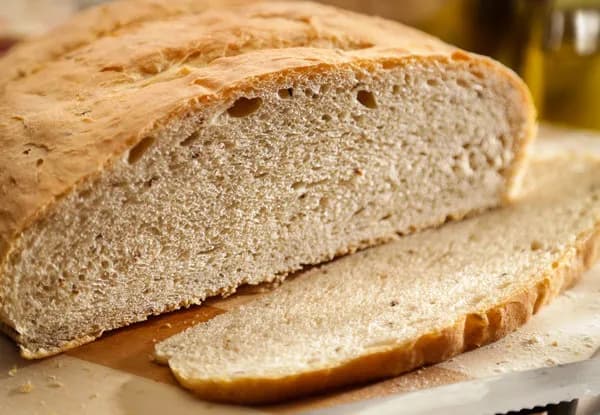
Classic Deli-Style Rye Bread
A tender, caraway-flecked sandwich loaf with a deep molasses-brown crumb and a crisp, burnished crust. It slices clean and holds up to anything you pile on it.
Ingredients
Makes 1 loaf (about 16 slices)
Dough
Finishing
Instructions
- 1
Wake up the yeast
Stir the warm water, yeast, honey, and molasses together in the bowl of a stand mixer. Let it sit for about 5 minutes, until the surface looks cloudy and a little foamy. If nothing happens at all, your yeast is past its prime — start over with a fresh packet rather than pushing ahead.
- 2
Mix the dough
Add the bread flour, rye flour, caraway seeds, salt, and softened butter. Fit the mixer with the dough hook and mix on low just until no dry flour remains, scraping the bowl once or twice. The dough will look shaggy and feel tackier than a plain white bread dough — that's the rye doing its thing, so resist the urge to dump in extra flour.
- 3
Knead until supple
Increase to medium-low and knead for 8 to 10 minutes. You're looking for a dough that pulls away from the sides, clears the bowl bottom, and feels smooth and slightly sticky to the touch. Rye has very little gluten of its own, so give it the full time — a pinch of dough stretched between your fingers should thin out before it tears.
- 4
First rise
Scrape the dough into a lightly oiled bowl, turn it once to coat, and cover. Let it rise at warm room temperature for 1 to 1 1/2 hours, until nearly doubled. A poked finger should leave a dent that fills back in slowly.
- 5
Shape the loaf
Turn the dough onto a lightly floured counter and press it into a rough 8 by 10-inch rectangle, pushing out the big bubbles. Roll it up snugly from a short end, pinching the seam closed as you go, then pinch the ends and tuck them under. Set it seam side down in a greased 9x5-inch loaf pan.
- 6
Second rise
Cover loosely and let rise for 45 to 60 minutes, until the dough crowns about an inch above the rim of the pan. Around the 30-minute mark, heat the oven to 375°F with a rack in the lower third.
- 7
Wash and slash
Whisk the egg white with the teaspoon of water and brush it over the loaf in a thin, even coat. Scatter on the extra caraway seeds if you want them. With a very sharp blade, cut three diagonal slashes about 1/4 inch deep across the top — a quick, confident stroke works far better than a slow saw.
- 8
Bake
Bake for 35 to 40 minutes, until the crust is deep mahogany and an instant-read thermometer in the center reads 195 to 205°F. If the top is browning faster than the inside is cooking, tent it loosely with foil for the last 10 minutes.
- 9
Cool all the way
Turn the loaf out onto a rack right away and let it cool completely, at least 2 hours. Rye crumb is still setting as it cools, and cutting early gives you a gummy, compressed slice — this is the hardest and most important step.
You did it! Help us bring baking back home by selling your delicious baked goods on Homebaked!
Baker's Tips
- 1.
Medium rye gives the best balance of flavor and structure. Dark rye makes a denser, earthier loaf; light rye makes a milder, fluffier one. All three work, but expect the rise to shrink as the rye gets darker.
- 2.
Keep rye flour in the freezer. It's higher in oils than wheat flour and goes rancid within a few months at room temperature, which shows up as a sharp, bitter aftertaste.
- 3.
If you like a more pronounced caraway flavor, crush half the seeds with the side of a knife before adding them. If you don't like caraway at all, leave it out entirely — the loaf is still excellent.
- 4.
Rye dough is meant to feel sticky. Flour your hands instead of the dough when shaping, and use a bench scraper to move it around.
- 5.
For a chewier, bakery-style crust, slide a shallow pan of boiling water onto the oven floor right as the loaf goes in and remove it after 15 minutes.
- 6.
Mixing by hand works fine. Combine everything with a sturdy spoon, then knead on a lightly oiled counter for 12 to 15 minutes.
Equipment
- Stand mixer with dough hook (or a large bowl and your hands)
- 9x5-inch loaf pan
- Bench scraper
- Instant-read thermometer
- Sharp blade or lame for slashing
- Pastry brush
- Wire cooling rack
Storage
Once fully cool, store cut side down on a board or in a paper bag at room temperature for up to 2 days — plastic softens the crust fast. For longer storage, seal in a zip-top bag at room temperature for up to 4 days, or slice the whole loaf, freeze it flat in a freezer bag for up to 3 months, and toast slices straight from frozen. Never refrigerate it; the crumb goes stale noticeably faster at fridge temperature.