How to Price Custom Cakes and Special Orders for Your Microbakery
A repeatable way to quote one-off bakes so you stop guessing, stop undercharging, and stop dreading the "how much would that be?" message.
Pricing a custom order is a completely different skill from pricing a dozen cookies. With cookies, you bake the same thing every week, you know what it costs, and the number barely moves. With a custom cake, every order is slightly new: different size, different flavor, different amount of piping, different amount of back-and-forth with the customer before you ever turn the oven on. That variability is exactly why so many home bakers end up quoting a number that felt fine in the moment and then spending eleven hours on a cake that earned them about four dollars an hour.
This guide walks through a pricing method you can actually reuse: figure out what an order truly costs you, decide what your time is worth, add overhead, then build a base price list so most quotes take you two minutes instead of twenty. None of this requires a finance background. It requires a calculator, honest math, and a willingness to charge for the parts of the job that are invisible to the customer.
Why Custom Orders Break Normal Pricing
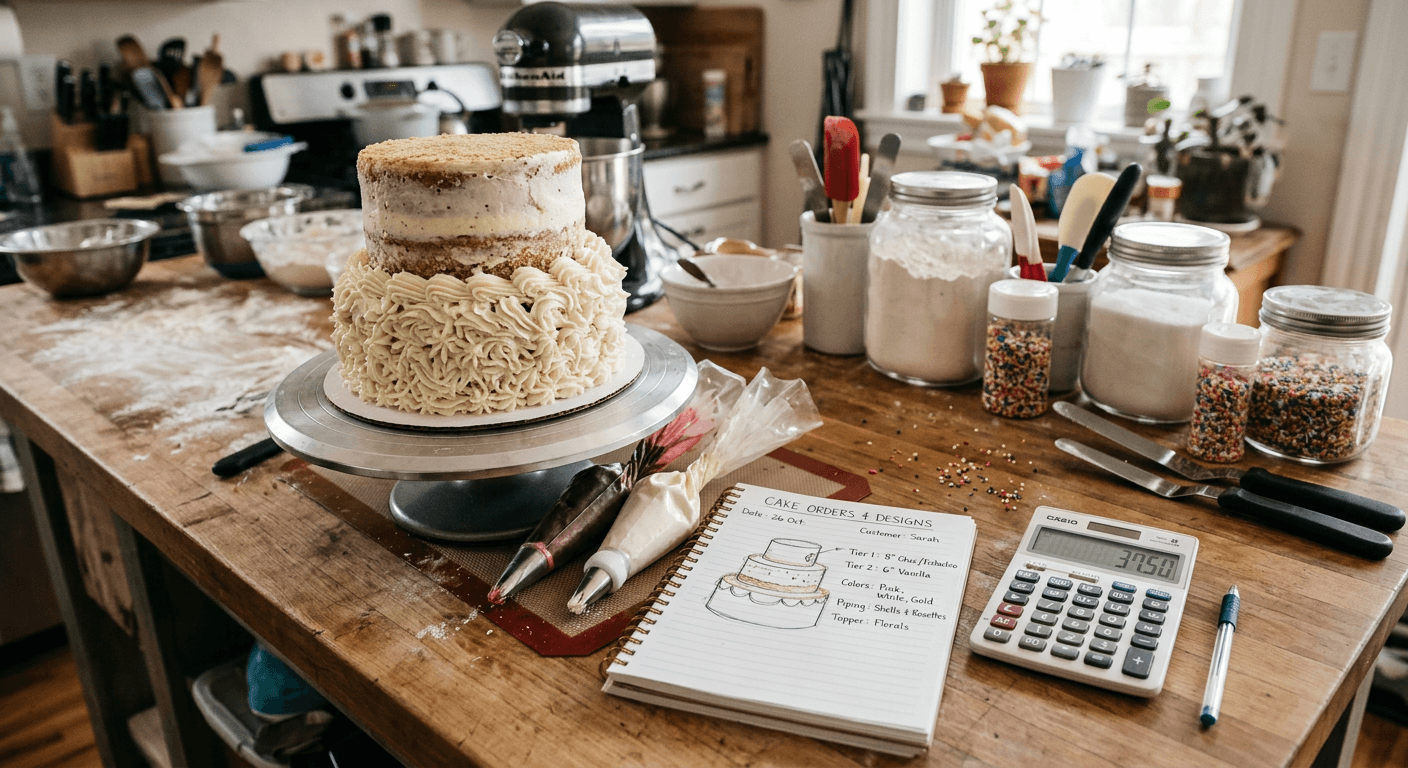
Standard menu items are predictable. You've made them enough times to know the yield, the bake time, and roughly how long cleanup takes. Custom work has no such history. A three-tier cake with hand-painted florals and a seven-inch smash cake share almost nothing except that both involve flour.
On top of that, custom orders carry hidden labor that never shows up in a recipe: the consultation messages, the sketch, the sourcing trip for a specific color of sprinkle, the delivery across town with the air conditioning blasting, the chilled hour you spent not touching it because the buttercream needed to set. If you only price the ingredients and the active baking, you're volunteering for everything else.
Step One: Find Your True Cost of Goods
Cost of goods is what you spend on things that physically leave your kitchen with the order. Ingredients, yes, but also the board, the box, the dowels, the ribbon, the cellophane, the sticker with your logo on it. Packaging is the line most new bakers forget, and on a decorated cake it can easily run eight to fifteen dollars.
To get a real number, price your ingredients per unit rather than per package. Here's the process.
- 1Write down the purchase price and total quantity for each ingredient (for example, a 5 lb bag of flour at $4.50 is 80 oz for $4.50, so $0.056 per oz).
- 2Convert your recipe to weight if it isn't already, since cups vary too much to cost accurately.
- 3Multiply each ingredient's per-unit cost by the amount the recipe actually uses.
- 4Add every non-food item that goes out the door: board, box, dowels, wrapping, label, candles, delivery bag.
- 5Add a 5 to 10 percent waste factor for trimmed cake scraps, test batches, broken chocolate work, and the batch of buttercream that split.
- 6Total it. That number is your cost of goods for that order.
Do this once per core recipe (your vanilla base, your chocolate base, your American buttercream, your Swiss meringue buttercream) and save it in a spreadsheet. After that, costing a new order is mostly adding saved numbers together rather than starting from scratch.
Step Two: Pay Yourself for Every Hour, Not Just the Pretty Ones
Pick an hourly rate and apply it to all the time the order consumes. If you're not sure where to start, look at what skilled hands-on work pays in your area and don't go below it. Decorating a cake is a trade skill, not a hobby you're being tipped for. Many home bakers land somewhere between $20 and $40 an hour, and experienced decorators with a waitlist charge well above that.
Track your hours on your next three custom orders before you commit to a number. Most people are genuinely shocked by the total. The categories worth logging:
- Consultation and messaging, including the quote itself and any design revisions
- Shopping and sourcing, especially special trips for one ingredient or color
- Prep: baking, cooling, leveling, filling, making fillings and frostings
- Decorating, which is usually the longest single block
- Cleanup, which is real work and routinely runs 30 to 60 minutes
- Packaging, boxing, and loading
- Delivery and setup, plus the drive back
You do not have to bill every one of these at your full rate, and plenty of bakers roll consultation and cleanup into a flat design fee instead. The point is that no category gets quietly donated.
Step Three: Account for Overhead
Overhead is the cost of being open at all, whether or not anyone orders this week. In a cottage bakery it's smaller than a storefront's, but it is not zero.
- Cottage food license, permits, and any required food handler certification
- Liability insurance
- Equipment you bought for the business and will eventually replace: mixer, turntables, pans, airbrush, tip sets
- The share of your electricity, gas, and water that the business uses
- Website or platform costs, card processing fees, and business software
- Marketing, business cards, farmers market or event fees
- Mileage and vehicle wear on deliveries
Add your yearly overhead, divide it by the number of orders you realistically expect to fill in a year, and you'll get a per-order overhead figure. Many small operations land somewhere between $5 and $20 per order. If you'd rather not do that math, a common shortcut is to add 10 to 20 percent of your subtotal as an overhead line.
Putting It Together: The Formula
Once you have those three pieces, custom pricing becomes arithmetic instead of anxiety.
- 1Start with your cost of goods, including packaging and waste.
- 2Add labor: your hourly rate multiplied by your realistic total hours.
- 3Add overhead, either as a per-order figure or as a percentage of the subtotal.
- 4Add profit on top, typically 10 to 25 percent. This is separate from your wage and it's what lets the business buy a new mixer without raiding your grocery money.
- 5Add delivery separately if it applies, based on mileage and time rather than being absorbed into the cake price.
- 6Round up to a clean number. A quote of $187.40 reads as nervous. $190 reads as a price.
Run the formula on a cake you've already sold and compare it to what you charged. If the formula's number is higher, that gap is what you've been absorbing on every single order.
Build a Base Price List So You Can Quote Fast
Doing the full calculation for every inquiry will exhaust you, and slow quotes lose orders. Instead, run the math once for a simple, lightly decorated cake at each size you offer. That becomes your starting price, and everything else is an add-on.
A base structure might look like a per-serving price for a simply finished cake, with tiers priced per tier, and then upcharges layered on top for anything that adds time or cost.
- Specialty fillings or flavors: curds, ganache, caramel, anything that requires a separate cook and chill
- Swiss or Italian meringue buttercream instead of American, since it costs more and takes longer
- Sharp edges, tall tiers, or fault-line and textured finishes
- Fondant work, modeled figures, and hand-painted or airbrushed detail
- Fresh florals, sugar flowers, or sourced toppers, charged at cost plus your handling time
- Rush orders placed inside your normal lead time
- Dietary modifications like gluten free or vegan, which carry higher ingredient costs and extra cleaning
- Delivery, setup, and any waiting time at a venue
Write these down and keep them where you can see them while you're answering messages. A posted structure also gives you something steady to point to when someone asks why one cake costs more than another.
Deposits, Lead Times, and Policies That Protect the Price
A good price falls apart without policies behind it. Custom work means you've bought ingredients and blocked out a day for one specific person, so the terms need to reflect that risk.
- Take a nonrefundable deposit, commonly 25 to 50 percent, to hold the date
- Collect the balance before pickup or delivery, not after
- Set a minimum order value so tiny custom requests don't eat an entire afternoon
- Publish a lead time (two weeks is typical for decorated cakes) and charge a rush fee inside it
- Put a cap on design revisions, or charge for additional rounds
- Spell out your cancellation window and what happens to the deposit
- Confirm every detail in writing, including flavor, size, colors, date, and address
The money side of this is where a lot of micro bakery owners get tangled up, juggling a payment app for deposits, a separate note for balances, and a mental list of who still owes what. Tools built for home bakers, Homebaked among them, take deposits and final payments through the same system and pay out directly to your bank account via Stripe, with no order fees added for you or your customer. One less place for a balance to go uncollected.
How to Deliver the Quote Without Apologizing
Quote the number plainly, in writing, with a short description of what it includes and a date it expires. No hedging, no softening language, no "is that okay?" at the end. If a customer's budget doesn't reach your price, the move is to offer them a smaller or simpler option, not to discount the work.
Something like: "A 7-inch two-layer cake with the gold detail you described, serving about 20, is $165. That includes the board and box, and pickup is Saturday after 10 a.m. This quote holds for seven days." Clear, finished, easy to say yes to.
You will lose some inquiries at that price. That is the system working. Price shoppers are not your customers, and there is a genuine market waiting on the other side of them: surveys put it at roughly 65 percent of households who'd rather get their bread and treats from a home baker than off a grocery shelf. Those people are not hunting for the cheapest cake in town, they're hunting for a real one.
Pricing Mistakes That Cost the Most
- Pricing against the grocery store bakery, which buys at volume and doesn't pay itself an hourly wage
- Quoting from memory instead of from a sheet, which drifts low over time
- Forgetting packaging, boards, and the waste factor
- Treating cleanup, shopping, and messaging as unpaid time
- Giving a friends-and-family rate to half your customer list
- Absorbing delivery into the cake price instead of charging it separately
- Never revisiting prices after ingredient costs rise
- Discounting to win an order you didn't really have room for anyway
Raising Prices Without Losing Your Regulars
Prices should move at least once a year, and sooner if butter, eggs, or chocolate jump. Raising them is less dramatic than it feels. Pick a date, give existing customers a few weeks of notice, honor any quote you've already issued, and then simply use the new numbers. Most people say nothing at all. The ones who book you for your work will keep booking you.
Increase in steps rather than one large leap, update your price sheet and anywhere your pricing is published on the same day, and resist the urge to explain or justify. A price list is information, not an argument.
A Last Word on Charging What It's Worth
Custom cakes sit at the center of people's biggest days, and that work deserves to be paid like skilled work. Once you've got the math written down, the quoting stops being emotional and starts being routine, which frees up the energy you'd been spending on second-guessing.
It also makes the business side worth building out. When pricing is solid, the next bottleneck is usually admin: tracking who ordered what, chasing balances, and sorting out sales tax at the end of the quarter. Platforms made for home bakeries handle that layer, calculating and filing sales tax automatically so a growing custom order list doesn't turn into a growing paperwork pile. Get the numbers right first, then let something else carry the clerical weight.