How to Be Successful on Homebaked
A practical guide to going from "I bake for friends" to a small home bakery people plan their weekend around.
Most home bakers don't start a business on purpose. It usually goes the same way: you bring a tray of cinnamon rolls to a work thing, somebody asks if you'd make two dozen for their kid's birthday, and suddenly you're running an unofficial bakery out of a DM thread. Homebaked exists to turn that moment into something real, with a storefront, orders, payouts, and tax filing all in one place instead of spread across five apps and a notes file. This guide walks through what actually makes a microbakery work once the account is set up, because the software is the easy part. The habits around it are what keep customers coming back.
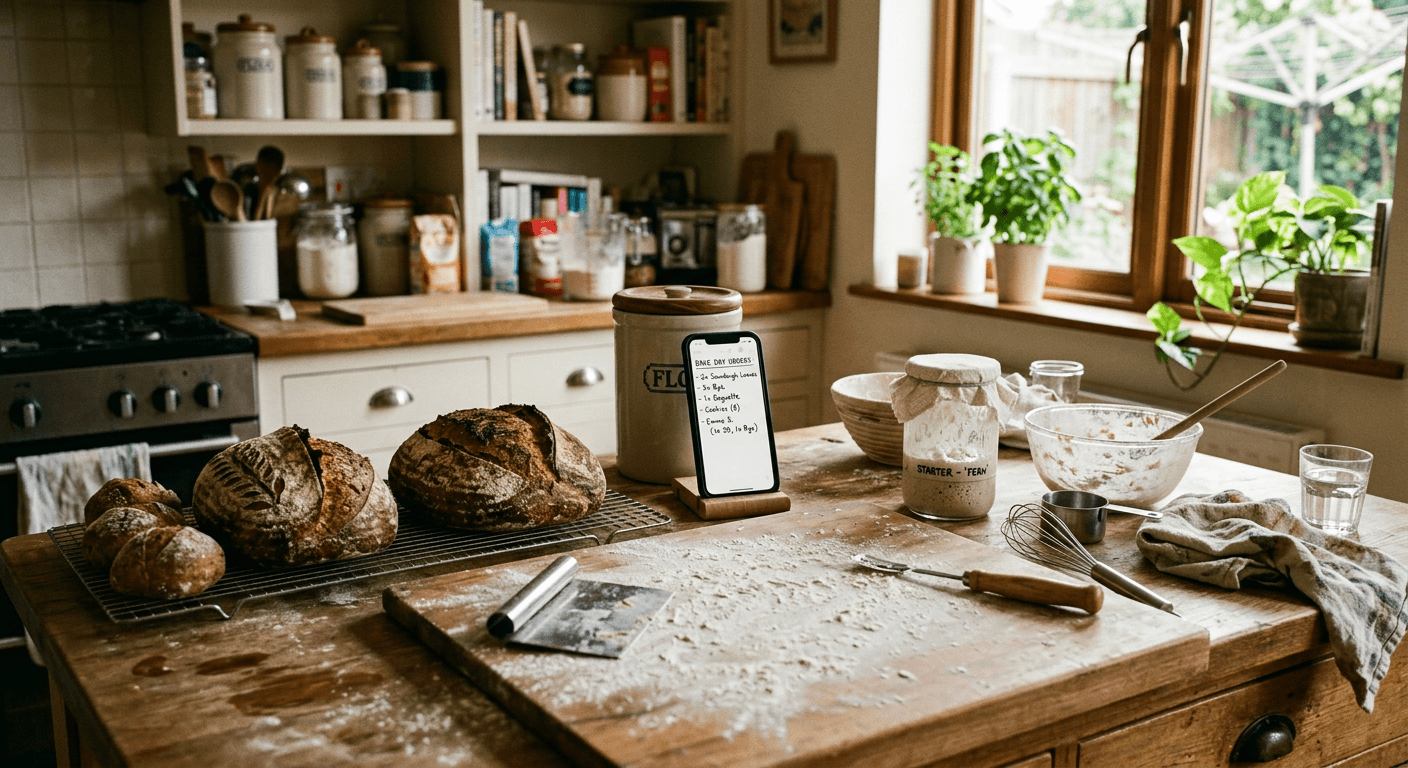
Worth knowing before you start: roughly 65% of households say they'd rather get their bread and treats from a home baker than off a grocery store shelf. The demand is already sitting in your neighborhood. The work is making yourself easy to find, easy to order from, and consistent enough that people stop thinking of you as a favor and start thinking of you as their bakery.
Start With a Menu That's Smaller Than You Want It to Be
The instinct is to list everything you can make. Resist it. A short menu means you buy fewer ingredients, you get faster at each item, and your quality stops wobbling from week to week. Three to five items is plenty for a first season, and it makes your bake day schedule something you can actually hold in your head.
Choose items that work in your favor logistically, not just the ones you're proudest of. The best starter menu items tend to share a few traits.
- They hold their quality for at least a day, so a late pickup doesn't ruin the product
- They scale up without scaling up your stress (doubling a cookie dough is easy, doubling laminated pastry is not)
- They travel without falling apart, especially if you'll do market tables or porch pickups
- They use overlapping ingredients, so one flour order covers most of your menu
- They're something you'd happily make fifty times, because you will
Get the Storefront Live Early, Not Perfect
A storefront on Homebaked takes about five minutes to set up and there's no hosting or website builder to wrestle with, which means the only real reason it stays unpublished is perfectionism. Publish it before you feel ready. A live page with three items and one decent photo will teach you more in a week than another month of tweaking descriptions will.
- 1Set your pickup or delivery windows first, since everything else is built around when you actually bake. Pick windows you can hit on a bad week, not a good one.
- 2Add your starter menu with plain, specific names and descriptions. "Brown butter chocolate chip, sea salt on top" beats "Signature Cookie."
- 3Photograph each item once, in daylight, next to something for scale. A phone on a windowsill is genuinely fine.
- 4Set your order cutoff far enough ahead that you can shop and prep without panic. Most bakers land on 48 to 72 hours.
- 5Connect your payouts through Stripe so money lands in your bank account without you chasing anyone for cash at the door.
- 6Share the link with the people who already ask you to bake. Your first ten orders are almost always people who know you.
Price Like a Business, Not Like a Friend
Underpricing is the single most common way a promising cottage bakery burns out. If your price only covers flour and butter, every order you take costs you money in the form of your own time, and the busier you get the worse that feels. Price the work in from the beginning. It's much harder to raise prices on an existing customer than to start at a number that's fair.
- Add up ingredient cost per batch, then divide by yield to get your true cost per unit
- Add packaging, labels, and the share of utilities that bake day eats
- Pay yourself an hourly rate for active work, including shopping, prep, cleanup, and messaging
- Build in a margin on top of all of that, because that margin is what buys your next mixer
- Check what a good local bakery charges, then remember yours is made to order, which is worth more, not less
One thing that helps here: there are no order fees on Homebaked, for you or for the customer. The price you set is the price they see and the price you're working from, so you're not quietly padding numbers to cover a platform's cut or watching a checkout fee make your cookies look more expensive than they are.
Keep Every Conversation in One Thread
The thing that actually breaks home bakeries isn't baking. It's a custom cake request that came in by Instagram DM, got confirmed by text, and had the allergy note buried in an email. Homebaked pulls messages from DMs, texts, and email into a single thread per customer, which sounds like a small convenience until the first week you have fourteen orders and no idea which one was the nut-free one.
- Confirm every custom detail in writing, in the thread, even if you agreed to it in person
- Repeat allergy and dietary notes back to the customer before you start baking
- Answer within a day during ordering windows, since response time is most of what "professional" means to a first-time buyer
- Keep a short saved reply for your most common questions (pickup location, lead time, what's gluten-free) so you're not retyping them
Build a Bake Day You Can Repeat
Consistency is the whole product. Customers aren't just buying a loaf, they're buying the confidence that next month's loaf will be the same loaf. That comes from a repeatable schedule, not from talent.
- 1Pick one or two fixed bake days a week and keep them the same. Predictability trains customers to order.
- 2Work backward from pickup time to build your timeline, including cooling and packing, which almost everyone forgets to budget for.
- 3Do all your shopping and mise en place the day before so bake day is only baking.
- 4Batch by oven temperature, not by product, so you're not waiting on the oven to swing 75 degrees between trays.
- 5Cap your orders at a number you've actually hit before, then raise the cap slowly as you learn your real ceiling.
- 6Write down what went wrong at the end of every bake day while it's fresh. That list becomes your system.
Make Packaging Part of the Product
Packaging does more work than it gets credit for. It protects the bake, it carries your name home with the customer, and it's the difference between "my friend made these" and "I bought these from a bakery." It's also where new bakers quietly bleed margin, because retail-priced boxes and bags add up fast. Homebaked's wholesale packaging runs about half of what the same supplies cost on Amazon, which matters most once you're buying in the hundreds rather than the tens.
- Standardize on one or two box or bag sizes so you're buying in volume instead of in onesies
- Use a sticker with your name and the item on it, which is cheaper and more flexible than custom-printed boxes
- Include storage and reheating instructions, since a loaf stored badly reflects on you, not on the customer
- Keep a packaging shelf stocked a month ahead so you never pay rush prices mid-season
Let the Boring Parts Run Themselves
Sales tax is the thing that stops a lot of people from ever turning a home bakery into an actual business. It feels like a reason to stay informal. On Homebaked it's calculated on each order and filed automatically, so it isn't a stack of paperwork you dread every quarter, it's just handled in the background while you bake. Pair that with direct payouts to your bank through Stripe and the administrative side of the business shrinks to something you can ignore most weeks, which is exactly where it belongs.
Separately, check your state or county's cottage food rules early. They vary a lot and they determine what you can sell, where you can sell it, and what your labels need to say. Nothing in this guide replaces reading your local regulations once, carefully, before your first sale.
Turn First Orders Into Regulars
Growth for a micro bakery almost never comes from reaching more strangers. It comes from the same forty people ordering more often. A customer who buys once is a nice week. A customer who buys monthly is a business.
- Use the built-in loyalty and promo tools to reward repeat orders rather than discounting to attract new ones
- Run a small seasonal item for two or three weeks only, since a deadline moves orders better than a discount does
- Ask your regulars what they'd buy if you offered it, then actually offer one of the answers
- Tuck a sample of a new item into an existing order instead of launching it cold
- Follow up once after a first order to ask how it went. Most bakers never do, and it's remembered
Mistakes That Slow People Down
- Taking on custom cakes before the core menu is dialed in, which turns every week into a one-off
- Saying yes to a rush order that wrecks the schedule for the paying orders already on the books
- Changing recipes mid-season, so returning customers get a different product than the one they liked
- Pricing by what feels polite instead of what the work costs
- Waiting for a perfect logo, perfect photos, or a perfect menu before publishing anything at all
- Scaling order volume faster than the kitchen, the oven, and the sleep schedule can handle
The bakers who do well at this aren't the ones with the most elaborate menus. They're the ones who picked a few things, made them the same way every time, showed up on the days they said they would, and let the admin side run itself in the background. Start smaller than feels impressive, get consistent, and let the neighborhood do the rest. There's already an appetite out there for food that comes from a kitchen down the street instead of a shelf.